Enregistrez-la dans votre nouvelle liste de favoris
Maximum 50 caractères
Économiser
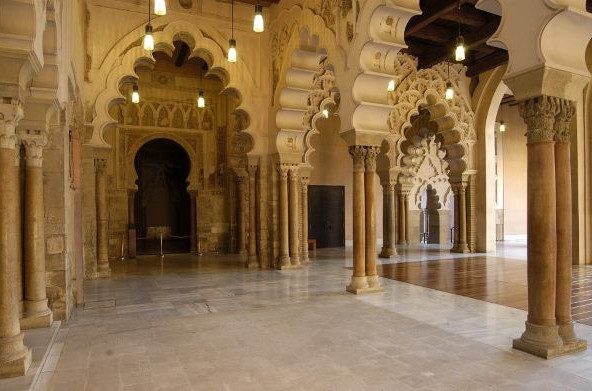
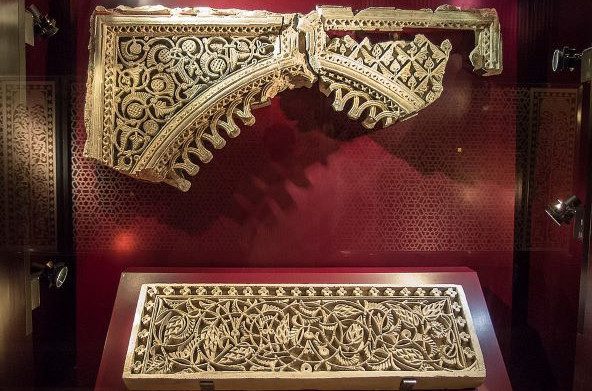
The Aljafería Palace was primarily built between 1065 and 1081 as a symbol of the powerful Taifa (independent Muslim kingdom) of Saraqusta, the Arabic name of Zaragoza, the capital of Aragon region. Its architecture stands as an icon of Islamic art developed on the Iberian Peninsula, distinguished by its spatial layout, geometric decorative patterns, and choice of materials.
Alongside the Alhambra of Granada and the Great Mosque of Cordoba, the Aljafería Palace in Zaragoza is one of the pinnacles of Islamic art that flourished in Al-Andalus. While the Great Mosque represents Caliphal art and the Alhambra stands at the height of Nasrid art, the Aljafería is the most significant example of Taifal art.
This stunning and historically rich palace is one of Zaragoza’s most beautiful and meaningful buildings. Its allure alone makes a visit to the city—a magnificent place by the banks of the Ebro River, situated between Madrid and Barcelona—absolutely worthwhile.
Here are some of the wonders and fascinating facts about this extraordinary monument:
From the Palace of Joy to Al-Yafar’s palace
In the mid-11th century, Zaragoza was one of the Taifas formed after the fall of the Umayyad Caliphate during the fitna period. But it wasn’t just any Taifa; it became one of the most powerful and culturally vibrant. Ruling over it was Al-Muqtadir, whose full name was Abu Yafar Ahmad ibn Sulayman. He ordered the construction of a fortified palace as a retreat from the pressures of governance—a place full of beauty and serenity. This became the Palace of Joy (Qasr al-Surur), as he named it.
Al-Muqtadir was so pleased with the outcome that he also used the palace for official ceremonies. As a result, it gained fame among travelers and chroniclers of the time, who began referring to it as Al-Yafar’s Palace (Qaṣr al-Ja’fariyah), which later evolved into the present name, Aljafería.
An astronomical observatory
Al-Muqtadir wasn’t just a skilled politician and military leader; he was also a wise and cultured king. Under his reign, Zaragoza became a prominent cultural center, attracting scholars and artists from across Al-Andalus.
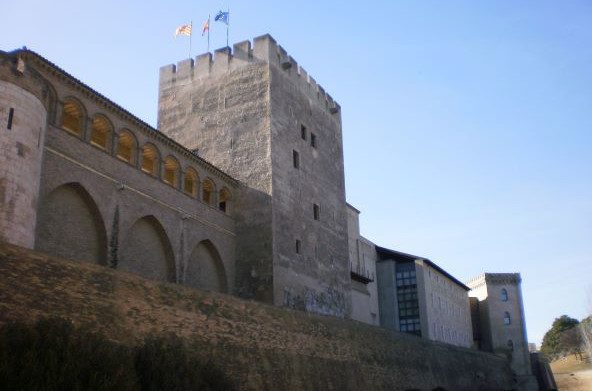
He even had his own astronomical observatory in the Torre del Trovador—the tallest and oldest tower of the complex, and the only one with a square base. From there, he observed planetary movements, studied the positions of the stars, and marveled at cosmic phenomena.
Al-Muqtadir’s son, Al-Mutaman, later became known as the “mathematician king,” one of Europe’s most important mathematicians during the Middle Ages.
Islamic arches and a saint
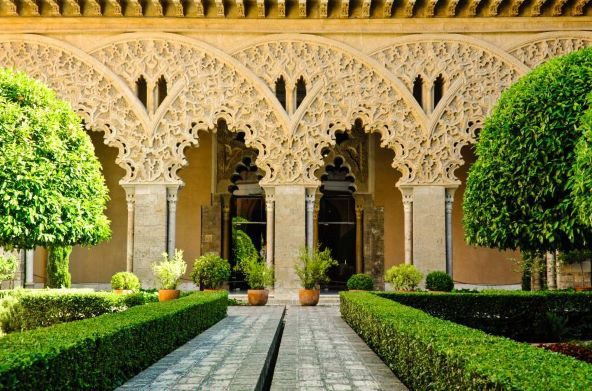
One of the most striking Islamic areas of the Aljafería has a surprisingly Christian name: the Courtyard of Santa Isabel.It’s an open-air courtyard at the heart of the Islamic building, surrounded by some of the most beautiful and captivating arcades made of plaster.
The courtyard is named after one of Aragón’s princesses who was born in the palace and later became the queen of Portugal, eventually earning sainthood.
The small mosque and Its Cordoba-inspired mihrab
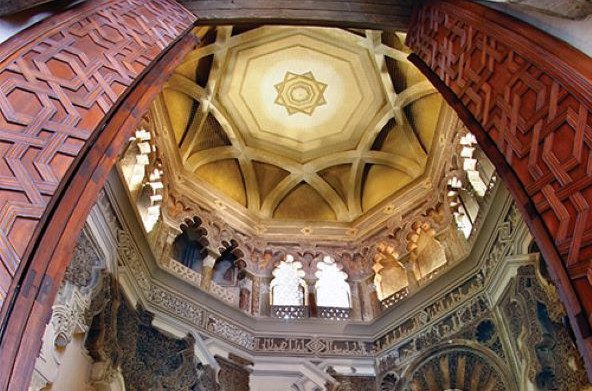
If you’ve visited the Great Mosque of Córdoba, the small private oratory built for Al-Muqtadir and his court within the palace will look familiar. Its mihrab, a deep, polygonal niche crowned with a shell, is a variation of the mihrab in the extension commissioned by Al-Hakam II in Córdoba. t’s not the only similarity to the Great Mosque of Córdoba.
Though the area appears colorless today, it was once adorned with vibrant geometric, vegetal, and epigraphic reliefs, painted in striking reds, blues, and golds.
A palace that’s really three palaces
Following the Christian conquest of Saraqusta in 1118, the palace remained mostly unchanged until the 14th century, when Peter IV of Aragon expanded the Islamic rooms. He added larger halls, bedrooms, and dining areas.
Later, the Catholic Monarchs, Ferdinand and Isabella, built their own palace in the northern wing, significantly transforming the Aljafería. So, while the exterior appears as a unified structure, it actually houses three distinct palaces: Al-Muqtadir’s Taifal Palace, Peter IV’s additions, and the palace of the Catholic Monarchs.
A ceiling worthy of World Heritage
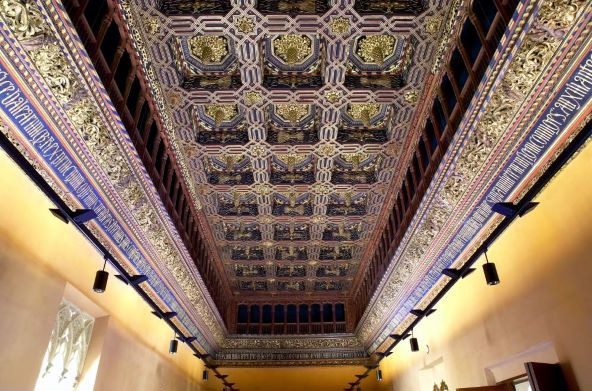
In the 15th century, the Catholic Monarchs commissioned a remarkable Mudéjar wooden ceiling for their Throne Room. The influence of Islamic aesthetics is unmistakable, with its intricate woodwork adorned with geometric patterns, eight-pointed stars, and vegetal designs. This masterpiece played a key role in earning the palace World Heritage status.
Varied and surprising uses
As we’ve seen, the Aljafería evolved from a serene retreat for Islamic kings to a display of their power, later becoming the residence and administrative center for Christian monarchs. Over time, it also served as a prison, the headquarters of the Inquisition, military barracks, and even the setting of a war.
Today, it is home to the Aragonese Parliament and various government offices, contributing to the region’s political and administrative life.
But there are wonders that words can hardly capture. Nothing compares to visiting the city of Zaragoza and its Aljafería Palace to discover them for yourself.
Visiting Hours:
November to March: Monday to Saturday, 10:00-14:00 and 16:00-18:30. Sundays, 10:00-14:00.
April to October: Monday to Sunday, 10:00-14:00 and 16:30-20:00.