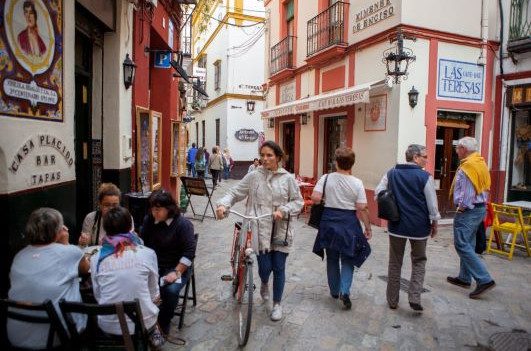
Knowing how to plan a halal trip to Spain makes all the difference: you can’t leave things to chance if you want to enjoy every moment. Based on our experience helping Muslim travelers plan their trips to and around Spain, we’ve put together twelve practical tips for a smooth, stress-free journey, from choosing the right dates and booking early to finding halal restaurants, mosques and Muslim-friendly hotels.
1. Think about your goal and the time required
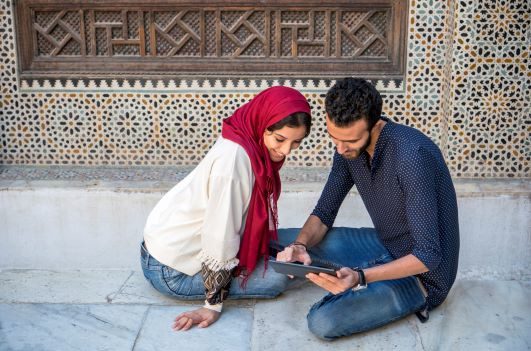
Planning ahead is the first step to a stress-free trip to Spain / ISTOCK
Is this your first trip to Spain? Is it relatively easy for you because you live nearby, enjoy several vacation periods throughout the year, or don’t mind paying for flights?
If you’re planning your first trip —or if you suspect that it might not be so easy to return— you’ll probably want to see “everything” or at least all the essentials. But trust us: that’s a lot. It requires a fair number of days and careful planning. For a first trip combining Spain’s major destinations with its Islamic heritage, Córdoba, Seville, and Granada —the great capitals and centers of power of Al-Andalus at different periods— will probably be high on your list. But there are also other unmissable destinations like Madrid, Barcelona, and even a hidden gem with an important Islamic legacy such as Toledo. For a quick overview, take a look at our guide to the top halal destinations in Spain for Muslim travelers.
If your time is limited —for both planning and visiting— it might be a good idea to join an organized tour. This way you can avoid dealing with itinerary planning or booking transportation and hotels. Organized tours have a big advantage: all the logistics are planned and synchronized to maximize your time and save on travel days. For instance, tours covering those cities generally last between 7 and 11 days, whereas, based on our experience, exploring them on your own would require around two weeks. If you’re traveling with children, you’ll likely need even more time.
If you’re not a first-timer and you know you’ll be visiting more than once, you can be more specific with your goals. For example, you can plan short trips to Madrid or Barcelona with a minimum stay of three or four days, plus a few extra days for interesting day trips to nearby places. Or, you could dedicate 7 to 10 days to a deeper exploration of Andalusia or choose a Mediterranean destination (Valencia, the Balearic Islands, the Costa del Sol…) for a break by the sea.
And if you’re an enthusiast of Islamic heritage, the possibilities are almost endless. You’ll find it in practically every region of Spain beyond Andalusia, with very few traces in the northern regions of Galicia, Asturias, Cantabria, and the Basque Country. Much of this heritage consists of alcázars and alcazabas, as well as impressive castles that were originally Islamic. And there’s plenty more to discover! Our guide to Spain’s most impressive alcázars and alcazabas is a good place to start.
2. Choose the right time
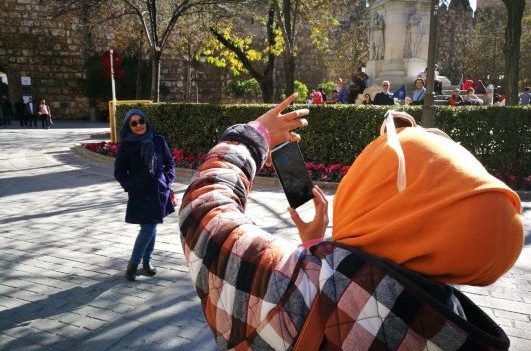
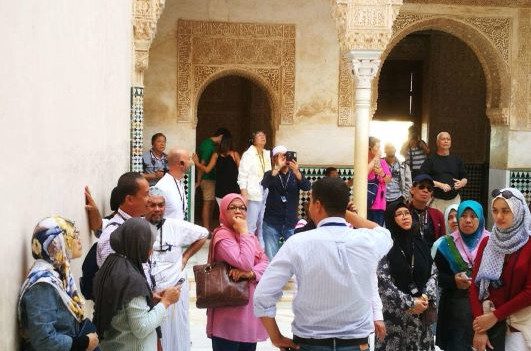
Visitors at the Royal Alcázar of Seville, one of the attractions worth booking in advance / LGH
Timing is the second element to consider—and it’s often closely tied to your objectives. We always say: any month can be a good time to visit Spain, but don’t overlook a few key points. First, consider the temperatures. Inland cities such as Madrid, Córdoba, Granada, and Seville experience great fluctuations throughout the year. Depending on what you’re used to, winters may seem cold or very cold (sometimes barely reaching above 10ºC), and summers —with increasingly frequent heatwaves— can be extremely hot, sometimes surpassing 40ºC. To avoid literally melting while exploring the streets, you’ll need to steer clear of the hottest hours and seek shelter indoors.
Besides temperature, certain months, festivities, and periods of the year see overcrowding and skyrocketing prices. Our post on the best time to visit Spain will help you pick the best time of year for your Spanish adventure.
And what about spending Ramadan or Eid in Spain?
It can be a special and different experience, giving you the opportunity to share these occasions with local Muslim communities. However, don’t expect to find Iftar or Eid menus everywhere. Only a limited number of halal restaurants offer them. Keep in mind that, particularly in Spain’s main tourist areas, many halal restaurants cater largely to a non-Muslim local and international clientele.
We’re working on a more complete list of restaurants offering special Iftar and Eid options and, insha Allah, hope to have it ready soon. In hotels, these services are exceptionally rare and would normally require arrangements well in advance. You may have better options through local mosques and Muslim communities, or at halal restaurants that specifically offer Iftar or Eid menus.
3. Plan your itinerary
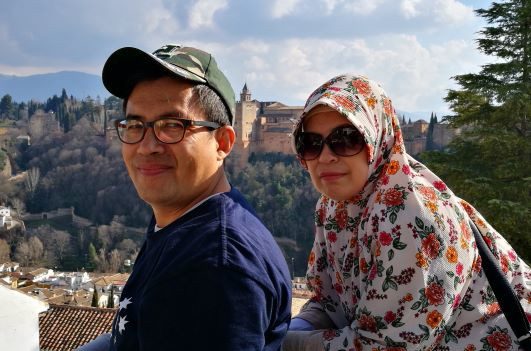
The Alhambra as seen from the Mirador de San Nicolás, in Granada / LGH
Once you’ve decided which cities or destinations you want to visit and when to go, the next step is to design your itinerary (unless you choose a ready-made package). Your itinerary will largely depend on where your journey begins and ends. Madrid, Barcelona, and Málaga are common gateways to Spain and useful starting or ending points for many itineraries. There are plenty of excellent connections between Spanish cities, so the order of stops can be adapted accordingly.
An essential factor in designing your itinerary is knowing the minimum time needed for each destination. As a general guideline, and based on our experience planning trips around Spain, Madrid and Barcelona require at least 3–4 days, plus an extra day for every excursion you plan (for example, visits to Toledo, Segovia, Tossa de Mar, etc.). Granada, Seville, and Valencia require two full days. Córdoba and Málaga call for at least one full day (meaning two nights), with an extra day if you want to explore the archaeological site of Medina Azahara (a World Heritage site on the outskirts of Córdoba) or a nearby spot along the Costa del Sol.
4. Check your visa and entry requirements well in advance
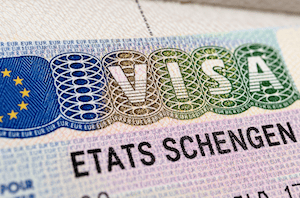
Visa processing can take longer than expected.
If you need a visa to enter Spain, don’t leave this until the last minute. Although Schengen visas are normally processed within 15 calendar days once an application has been submitted, the process can sometimes take longer, and you should also allow time to obtain an appointment and prepare the required documentation.
Before making non-refundable bookings or spending money on your trip, check the requirements and expected processing times with the Spanish Embassy or Consulate responsible for visa applications in your country.
You may already be familiar with the Schengen Area. In simple terms, a Schengen visa is generally valid throughout the countries that form part of this European area, allowing you to travel between them without internal border checks. However, temporary border controls can be introduced in exceptional circumstances.
Two newer concepts may be less familiar. The Entry/Exit System (EES), operational since April 2026, is an electronic system that registers non-EU nationals traveling for a short stay when they enter and leave the participating European countries. ETIAS, on the other hand, is a new travel authorization for nationals of visa-exempt countries. It is not yet in operation, and its exact launch date has not yet been announced.
So, to make sure none of this comes as a surprise when planning your trip, check the latest information. Spain’s official tourism website provides up-to-date information on visa and passport requirements, the Schengen Area, EES, ETIAS, and other documentation you may need to travel to Spain.
5. Remember that prices are dynamic
Book flights, trains and hotels early: prices rise as the date approaches / UNSPLASH
Dynamic pricing means that costs change according to demand. Higher demand drives prices up, especially as the date for a service draws nearer. Airlines, high-speed trains, and hotels all use this strategy. Booking early isn’t just about ensuring availability or securing tickets, it can also help you avoid steep price increases.
If you’re traveling during a particularly busy period, we recommend starting your bookings three or four months in advance. And if your dates are fixed, there is usually little advantage in waiting unnecessarily to make your reservations.
6. Choose and book the right transportation
High-speed trains are often the most convenient way to travel between Spain’s main cities
If you’re coming from a nearby country or considering renting a vehicle in Spain, think twice if your trip is mostly city-based. Many Spanish cities have low-emission zones and other traffic restrictions affecting access to central areas. If you’re unfamiliar with these zones, you risk entering them unintentionally and ending up with a fine. The best and most practical option may be to park your vehicle (though parking isn’t always cheap).
We recommend booking accommodation in central locations, within walking distance of the main attractions, and using public transportation when you need to move around. The metro and buses are great options—public transportation is generally safe and efficient, but beware of pickpockets, particularly in crowded tourist areas—and taxis are often cheaper than in many other major European cities.
For intercity travel, unless you opt for a luxury private car with a driver (which comes at a premium), high-speed trains are often the most convenient option between Spain’s main cities. Renfe operates AVE and AVLO high-speed services, while Iryo and OUIGO also connect a growing number of Spanish cities. Remember, high-speed train prices are dynamic too, so book early.
7. Find and book Muslim-friendly hotels
Ask your hotel in advance about halal food options
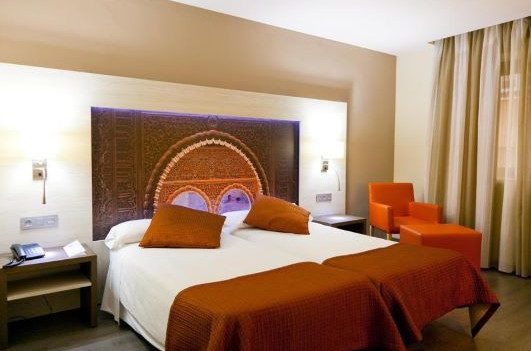
There aren’t many hotels in Spain catering specifically to the needs of Muslim travelers, but those that do exist are usually in the key destinations you plan to visit.
In Spain’s main tourist cities, 5-star hotels quite often offer halal food options on request. Some 4-star hotels do as well, although this is less common. You’ll need to ask in advance, as this service isn’t always available by default and is generally provided upon customer request.
The good news is that hotel buffets are often varied, generous, and Mediterranean-inspired, with vegetables, legumes, rice dishes, fish, fruit, bread, cereals, and eggs among the options you may find. If you ensure that your hotel offers at least a buffet breakfast, chances are you’ll find some options that suit your own halal requirements and tastes. If in doubt about ingredients or preparation, ask the hotel staff.
Other Muslim-friendly services are still relatively uncommon in Spanish hotels. A few hotels may provide prayer mats, for example, or their staff may be familiar with nearby halal restaurants. Removing alcoholic drinks from the minibar or room on request, where they are provided, is more common.
In our experience, modest swimwear is generally accepted in hotel pools, although individual hotel policies may vary.
If you’re traveling with family, also consider the availability of family rooms, which can be scarce. Many hotels only offer double rooms with an extra bed for a child, which aren’t truly designed as family accommodations. Connecting rooms or rooms for four people are hard to come by. In our section on Muslim-friendly hotels, you’ll find a selection of establishments with services tailored to your needs, including family rooms that accommodate more than three people.
We recommend choosing hotels that are centrally located or near the main points of interest. While accommodations outside the city center might offer lower rates, consider the extra time and cost involved in commuting to tourist areas: it might not be worth the price difference. Additionally, most halal restaurants are located in central areas.
8. Plan where to pray
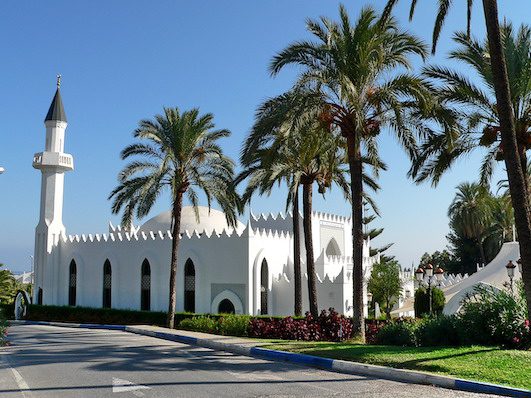
King Abdulaziz Mosque, on Marbella’s Golden Mile (Málaga province) / ISTOCK
If praying at a mosque is important to you during your trip, it’s a good idea to check their locations in advance and take them into account when planning your day. Unlike halal restaurants, mosques are not always easy to find close to the main tourist areas, particularly in large cities such as Madrid or Barcelona.
Córdoba, Granada, and Seville are the only major tourist cities in Spain where you’ll find mosques or Islamic centers within the historic center. An important warning about Córdoba: don’t assume that the Great Mosque of Córdoba—officially the Mosque-Cathedral of Córdoba—is a place where you can perform your prayers. Despite its name and Islamic origins, Muslim prayer is not permitted inside the monument.
In Málaga, Valencia, and some towns along the Costa del Sol, you’ll also find mosques in relatively central locations. In Madrid and Barcelona, however, the larger mosques and Islamic centers are generally farther from the areas where most visitors spend their day. There are some mosques closer to central and tourist areas, but they tend to be small and very modest.
Before setting out each day, check which mosques are convenient for your itinerary and take their location into account when planning your visits. A little preparation can save you from having to change your itinerary or travel across the city when it’s time to pray.
In Let’s Go Halal’s Mosques section, you can find mosques and Islamic centers in the different destinations, with practical information to help you locate them and plan your visit. And once you’re in Spain, our Let’s Go Halal App can make things even easier: it shows mosques on the map and lets you plan your route to them, provides automatic prayer times based on your current location, and includes a Qibla finder.
9. Book tickets in advance, especially for the Alhambra!
The Court of the Lions, in the Nasrid Palaces of the Alhambra, is visited with a timed ticket
We’re convinced that the Alhambra is one of the highlights of your trip—the most beautiful Islamic palace on the planet simply cannot be missed. In fact, it’s on the wish list of thousands around the world, which poses a challenge: due to its limited visitor numbers, getting tickets —especially during busy periods— can be quite a challenge. It’s not uncommon for travelers who didn’t plan ahead to leave Granada without seeing the Nasrid Palaces and their stunning Patio of the Lions, one of the highlights the Alhambra.
To avoid that being your case, purchase your tickets as far in advance as possible. And pay special attention to the time: your ticket to the Nasrid Palaces comes with a specific admission time, and that time can determine how you organize the rest of your day in Granada. If you’re visiting independently, the official Alhambra ticketing website is the best place to secure your entry.
If you prefer to discover the Alhambra with a Muslim guide, Let’s Go Halal can also take care of the tickets as part of our private guided visits. Subject to availability, we look for the admission time that best fits your itinerary and needs.
The Alhambra isn’t the only attraction where early ticket purchase is essential. Barcelona’s Sagrada Família is another place where leaving your booking until the last minute can mean finding no tickets available for the day you planned to visit. Advance booking is also highly advisable for other major attractions, such as Park Güell in Barcelona, the Royal Palace in Madrid, or the Real Alcázar in Seville.
10. Select and plan your halal restaurants
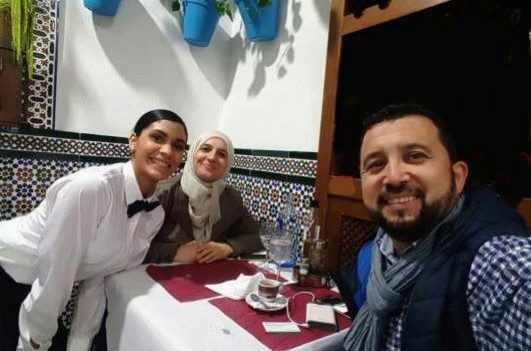
Dining in Córdoba: check in advance which restaurants serve halal food
It might seem like over-planning, but having a few selected halal restaurants near your accommodation or the attractions you’re visiting will enhance your experience and save you unnecessary time. Is finding halal restaurants in Spain difficult? Not at all, especially in key tourist destinations like Madrid, Barcelona, Seville, Córdoba, Granada, Málaga, the Costa del Sol, and Valencia. However, the number of halal establishments is still limited, and they’re not always clearly marked.
Many restaurants serving halal food in Spain don’t display a halal sign outside—or even inside the restaurant. Many Moroccan, Lebanese, Syrian, Indian, and other restaurants offering halal food cater mainly to a general Spanish and international clientele rather than specifically to Muslim customers, so halal may not be something they visibly advertise.
Our carefully curated selection of restaurants will guide you. All the restaurants included in Let’s Go Halal have been checked directly with the establishment regarding the halal food they offer, and we indicate the type of halal or alternative food available:
Full halal food
Some halal food
Seafood
Full halal – No alcohol
Veg. and vegan
This allows you to choose according to your own halal requirements and preferences. You’ll also find useful and accurate information on the type of cuisine offered, the main specialties, opening hours, available services, price ranges, and user ratings.
11. Nothing beats a good guide for a top experience
A Muslim guide can bring the history of the Alhambra to life / LGH
If your trip is focused on cultural exploration and you have several must-see attractions, having knowledgeable guides can make all the difference, especially when exploring Islamic heritage. A Muslim guide, or one specialized in Islamic art and culture, can offer you an incomparable experience and insights that most other guides cannot.
You can find Muslim or specialized guides to visit cities such as Córdoba, Granada, Seville, Málaga, and Toledo—as well as Madrid, Barcelona, and Valencia.
If a private guide is beyond your budget, we recommend at least joining a regular group tour. It may not offer the same perspective on Islamic heritage, but you’ll still gain a much better understanding of what you’re seeing.
Visiting extraordinary attractions like the Alhambra in Granada or the Mosque of Córdoba without a guide to help you grasp their full significance is like trying to enjoy a dish from the world’s best chef when a cold has blocked your sense of smell. Truly a shame!
12. Mind the local timetable
Spanish schedules for meals and shops differ from those in many other countries / ISTOCK
Knowing local customs—especially the schedule—is essential for a smooth trip. Spanish schedules are one of the first things that might catch your attention, as they differ from those in other European countries (and probably from what you’re used to). Keep these pointers in mind:
Breakfast can be enjoyed between 7:00 AM and as late as 11:00 or even 12:00 noon.
Lunch is typically served from 1:00 PM to 4:00 PM, and dinner between 8:00 PM and 10:30 PM; in large cities and during summer, dinner might extend to as late as 11:30 PM, or even later.
Keep in mind that, except for restaurants with continuous kitchen service, if you find a place serving lunch before 1:00 PM or dinner before 8:00 PM… it’s probably “catering” to tourists. Is that really where you want to dine?
Sunday is usually the day when shops and businesses close.
Hotel check-in usually starts at 2:00 PM, with check-out around 12:00 PM.
Store hours in city centers and tourist areas are generally from 10:00 AM to 9:00 PM, though some close between 2:00 PM and 5:00 PM—especially in summer.
Public buses in major cities typically run from 6:00 AM to 11:00 PM, while metro services often extend until midnight or 1:00 AM. From 11:30 PM to 6:00 AM, night services are usually available.
Feeling overwhelmed by all these?
Don’t worry! You always have the option of choosing one of our organized tours, with different ways of traveling around Spain, or even hiring a professional to craft a personalized, tailor-made itinerary built around your individual preferences and priorities.
But here’s another way to look at it: planning your trip is also part of the excitement, it’s the beginning of your journey. Researching destinations, mapping out your itinerary, discovering the best halal restaurants, and selecting your ideal hotels are all part of the fun.
From the bustling streets of Madrid and Barcelona to the rich Islamic heritage of Córdoba, Granada, and Seville, and the beautiful Mediterranean coast, Spain is waiting for you. Whether you’re designing a seamless itinerary on your own, relying on an expert, or mixing both approaches, the adventure starts now. Start planning your halal trip to Spain, and start enjoying your journey. Happy travels!
Frequently asked questions about planning a halal trip to Spain
Based on our experience helping Muslim travelers plan their trips around Spain, these are some of the questions we’re asked most often. Here are our quick answers.
How many days do I need for a first trip to Spain?
Tours focusing on Córdoba, Granada, and Seville usually take between 5 and 7 days. If you also want to include other major cities such as Madrid, Barcelona, or both, allow around 7 to 10 or 11 days. If you’re traveling independently, especially with children, you may need a few extra days. For a more complete first trip, around two weeks is a good guideline.
When should I book?
For busy periods, we recommend booking three or four months in advance. Alhambra tickets should be booked as far in advance as possible, especially during peak periods.
Is it easy to find halal food in Spain?
n key destinations, yes, although options are still limited and not always clearly signposted. The halal status of restaurants listed on this website is checked directly with each establishment.
Can I pray in the Mosque of Cordoba?
No, Muslim prayer is not permitted inside the monument, officially known as the Mosque-Cathedral of Córdoba.
Do hotels in Spain offer halal food?
5-star hotels in major cities often offer halal food on request, while this is much less common among 4-star hotels and highly unlikely in lower categories. Always ask in advance.