A Muslim visitor listens to an artisan explaining traditional wood inlay techniques at Laguna Taracea in Granada. / LET'S GO HALAL
“What are some things to do in Granada besides visiting the Alhambra?” That’s a question we’ve often heard from Muslim travelers throughout more than 12 years of assisting them and providing travel services in Spain.
That long experience has also led us to a few certainties: Granada is a must on their travel wish list, and the Alhambra takes the number one spot on their list of must-visits. Of course, you don’t have to be an expert to figure that out, do you?
But knowing what else could make their experience in the city richer and more rewarding… Ah, that’s a different story, because we’re no longer talking about the obvious. And that’s precisely what we want to do here: give you some good ideas and help you make the most of Granada by choosing the things that will interest you most. And that you’ll enjoy most. Experiences that connect with different aspects of the history, culture and heritage of Al-Andalus and that are also among the “good things in life.”
So, if you’re planning your trip, allow us to offer a few tips before we get to the heart of the matter.
First, take a look at our article on how to plan a hassle-free halal trip to Spain. It will give you some useful pointers on the general aspects you should consider before getting started.
Second, and we can’t say this often enough, buy your Alhambra tickets as early as possible. Getting hold of them, believe us, can often become quite a challenge. Our complete guide to Alhambra tickets can be a great help.
Third, decide which other monuments and attractions you’d like to visit. Granada was the capital of the last Muslim kingdom of Al-Andalus, and its heritage is extraordinary: the Albaicín, the Alcaicería, the Corral del Carbón, the Bañuelo, the Madrasa… In our Things to do in Granada section, you’ll find more than a dozen places well worth visiting.
And finally, the reason for this article: what other experiences could make your stay in Granada even more rewarding? Take note of these five ideas. We know you’re going to love them.
Experience the Great Mosque of Granada
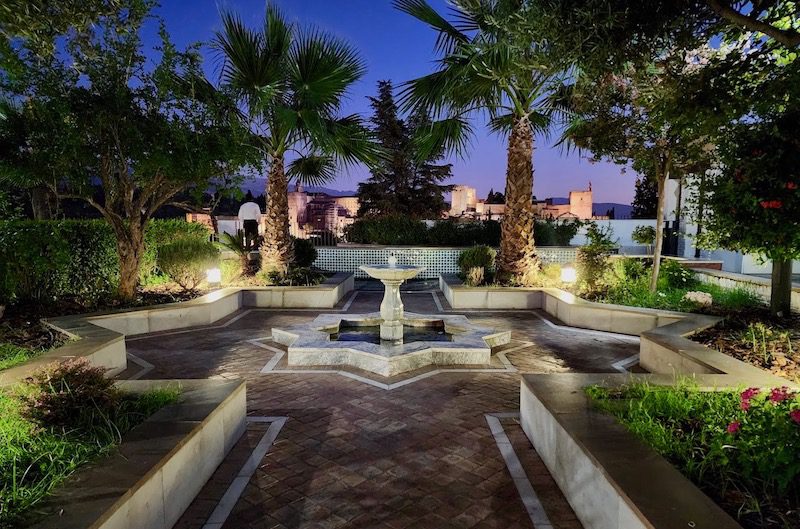
The garden viewpoint of the Great Mosque of Granada at dusk, with the Alhambra in the background. / NASEEMA BARDAY
Of the three main established mosques in Granada and its surroundings, the Great Mosque, at the top of the Albaicín, is undoubtedly the most emblematic. That’s partly because, built in 2003 after decades of effort by the local Muslim community, it was the first mosque purpose-built for Muslim worship in Granada in more than five centuries.
It’s also emblematic because of its iconic location: right in the heart of the Albaicín, the city’s oldest and most authentically Andalusi neighborhood. A neighborhood that, following the Christian conquest of Granada in 1492, remained one of the city’s main centers of Muslim population. And, as if that weren’t enough, it also enjoys privileged views of the Alhambra.
In the beautiful mosque’s garden, surrounded by Mediterranean trees — olive, orange, lemon, pine and pomegranate — and a mosaic fountain with an Andalusi feel, you can enjoy this spectacular panorama in greater peace and tranquility than almost anywhere else in the city. And, while you’re there, if the pastry seller is around, treat yourself to some delicious mint tea and sweets.
You’ll also have the opportunity to meet members of Granada’s thriving local Muslim community, along with many other Muslims who have come from all corners of the world. And in the entrance courtyard leading to the mosque complex, you’ll find a shop selling books, souvenirs and local handicrafts.
The memory of this mosque will stay with you as that of a truly unforgettable place.
The mosque is open from 11:00 a.m. to 2:00 p.m. and from Asr to Isha.
Dimana: Plaza de San Nicolás, s/n.
Discover Andalusi ceramics in the Albaicín: Al Yarrar
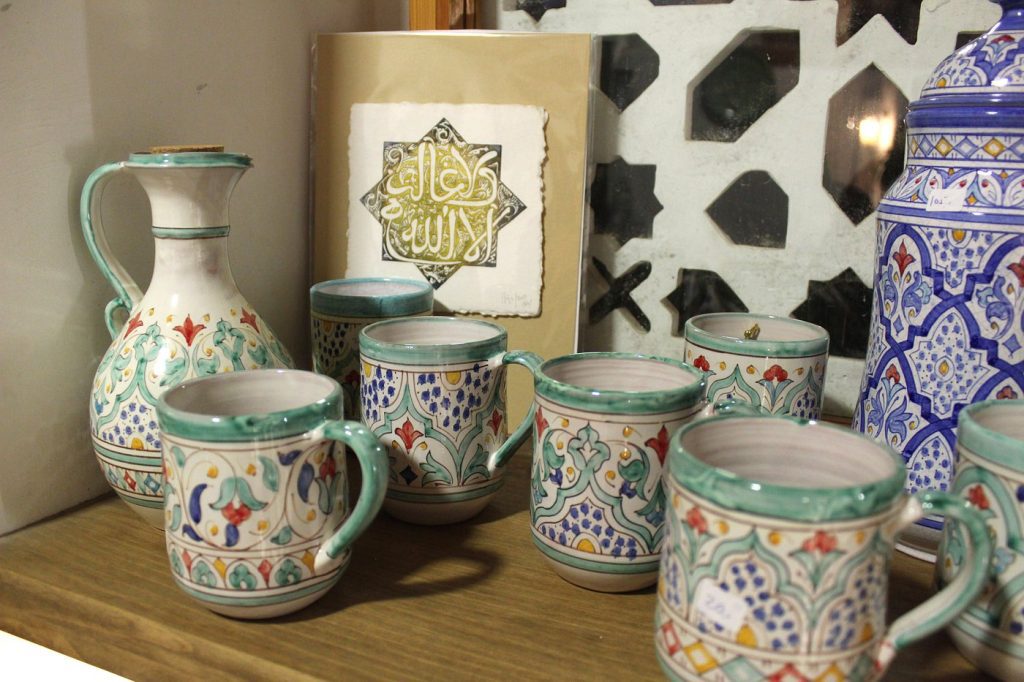
Traditional Andalusi ceramic pieces handcrafted at Cerámica Al Yarrar. / CERÁMICA AL YARRAR
Without leaving the Albaicín, less than a five-minute walk from the Great Mosque, you can enjoy another of the experiences we recommend. If you love traditional crafts, you’re going to love this one. Not only because of the beauty and the profound legacy of tradition and culture embodied in every ceramic piece, handcrafted from start to finish. But also because of the very special place where you’ll find it: a 16th-century Morisco house restored by the family who live there, respecting its original structure and period materials.
The Moriscos were Muslims who were forced to convert to Christianity under Christian rule, although many continued to preserve their Islamic faith and traditions in secret. They were eventually expelled from Spain in the early 17th century.
We’re talking about master craftsmen Bernardo Sánchez and his son Sebastián, Muslims from Granada who, since 1983, have dedicated themselves to recovering, researching and faithfully reproducing the techniques, glazes, tiles and mosaics of the ceramic tradition of Al-Andalus.
At Cerámica Al Yarrar, every piece is unique. Nothing is mass-produced; quite the opposite, everything is made by hand, piece by piece.
They have three collections. The Andalusi collection, inspired by the style of Al-Andalus between the 12th and 14th centuries, with its characteristic Granada blues and greens. The Nasrid collection, made using the metallic luster technique employed in the Kingdom of Granada during the 14th and 15th centuries. And the Caliphal collection, which reproduces pieces from the Umayyad period, between the 10th and 11th centuries, whose originals are held in museums.
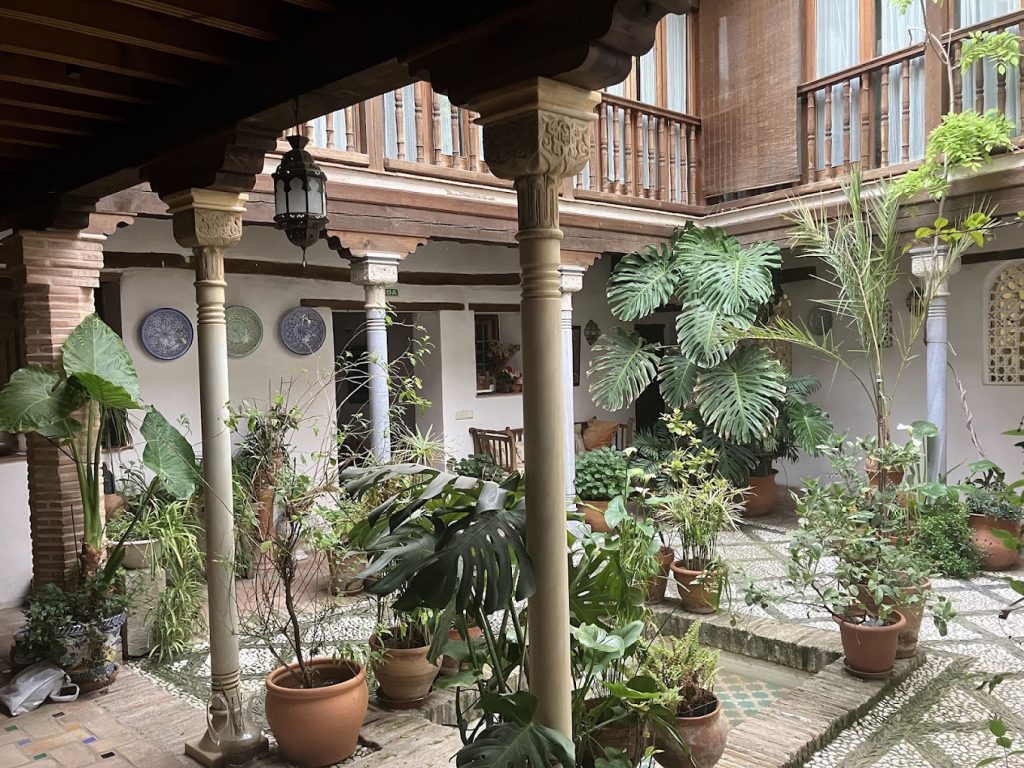
At Casa-Tienda Al Yarrar, you won’t find an ordinary shop. You’ll have to ring the doorbell to enter this charming Morisco house with its courtyard and, in the peaceful atmosphere inside, admire these wonderful ceramic pieces. Without a doubt, an experience in itself.
Dimana: Calle Minas del Albayzín, 11.
Interior courtyard of Cerámica Al Yarrar in Granada’s Albaicín neighborhood. / CERÁMICA AL YARRAR
A journey into the world of olive oil at Olearium
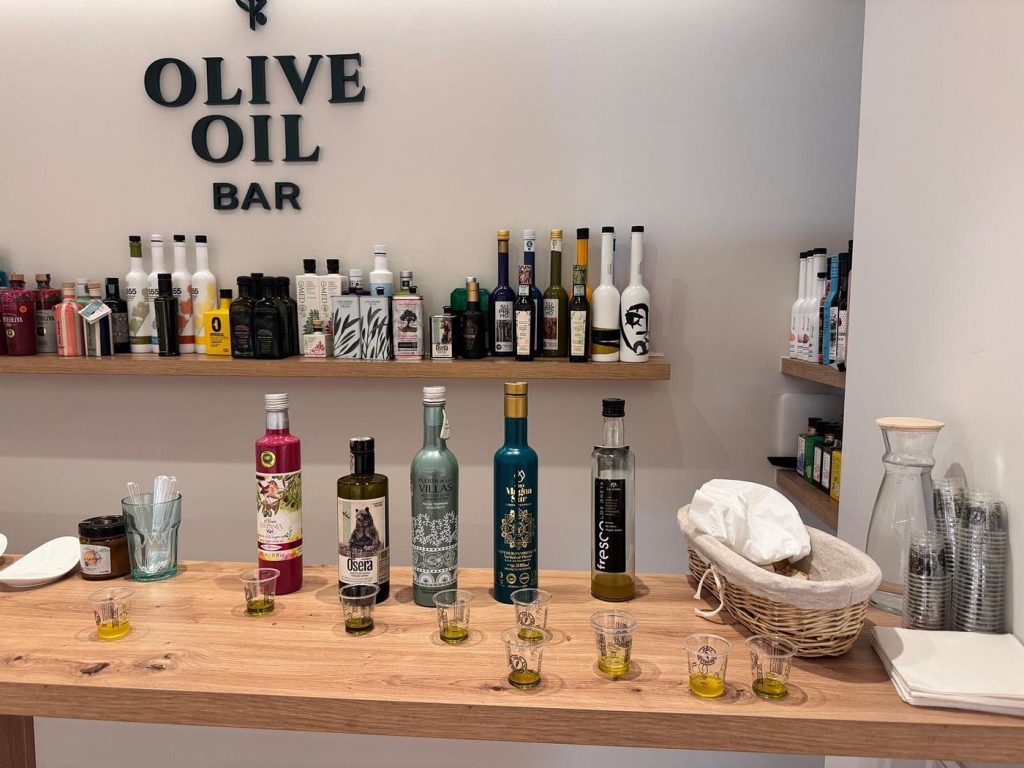
Interior of Olearium in Granada, dedicated to tasting and discovering extra virgin olive oils. / OLEARIUM
For the next experience, you’ll need to leave the Albaicín and head for Granada’s historic center. There, less than 100 steps from the Cathedral — built on the site of what was, until the late 15th century, the city’s main mosque — you’ll find Olearium, the world’s first “Olive Bar,” or “Extra Virgin Olive Oil Bar,” as it describes itself.
And what’s that, you may be wondering? Let’s start at the beginning. In Spain, the acronym AOVE is very familiar. It stands for Aceite de Oliva Virgen Extra, or extra virgin olive oil (EVOO). We’re not talking about just any olive oil. We’re talking about the highest-quality olive juice there is, obtained directly from the fruit using mechanical processes only, without chemical treatments, with a maximum free acidity of 0.8% and no sensory defects whatsoever.
In other words, the very finest olive oil, recognized as an official quality category for which oils must pass physicochemical tests and a sensory evaluation carried out by a panel of trained expert tasters to earn that highly prized designation.
Well, what Olearium does is dedicate a counter, an actual “olive bar,” to tasting and appreciating extra virgin olive oils, rather like a wine bar or enoteca does with wine. Through a guided tasting, you can sample, appreciate and compare different varieties of EVOO from different parts of Andalusia, learning to distinguish and appreciate their individual nuances.
You can also choose from a carefully selected range of premium extra virgin olive oils in different formats: to enjoy, cook with or give as gifts. As well as other artisanal and premium products, both food and cosmetics.
“We believe that olive oil is much more than an ingredient. It’s part of our history, our culture and our way of understanding life,” they say at Olearium. And they’re absolutely right! Today, olive oil is one of Spain’s most emblematic products and a star of its gastronomy. Spain is the world’s leading producer of olive oil.
It was the Romans who expanded olive cultivation and turned Hispania into a major producer and exporter of olive oil in the ancient world. Centuries later, the Andalusis continued and enriched that tradition, developing cultivation techniques and using olive oil not only as an ingredient in their cuisine, but also in cosmetics and medicine.
Your trip to Spain and Andalusia won’t be complete without enjoying the very best olive oil and learning how to truly savor it. And Olearium is the best place to do so in Granada.
Dimana: Calle Libreros, 6.
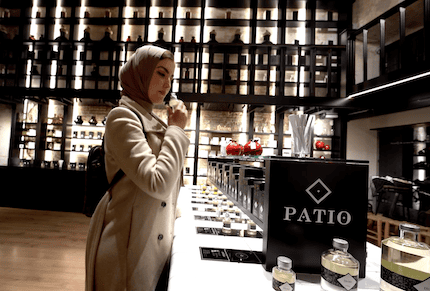
Explore the scents of Al-Andalus at Patio de los Perfumes
A Muslim traveler exploring different fragrances at Patio de los Perfumes in Granada. / LET’S GO HALAL
Spices and fragrant essences hold an important place in Islamic tradition, and they were equally important in Al-Andalus.
In Islamic Spain, aromas and perfumes played a prominent role in everyday life, medicine, religion and court ceremonies. Andalusi culture placed great importance on the sense of smell, associating it with well-being, hygiene, refinement and social prestige. Aromatic substances were appreciated by men and women from different social classes, although the most exotic and expensive ones were particularly associated with the elites.
Many of the most prized aromatic ingredients reached Al-Andalus through extensive trade networks connecting Southeast Asia, India, Arabia, Persia, East Africa and the Mediterranean. During the Nasrid period, ports such as Málaga and Almería were important gateways to Granada. The rarity of certain ingredients and the difficulties involved in transporting them made them genuine luxury goods, comparable to gold, silver or silk.
During the Caliphate period, the Masjid Agung Cordoba was perfumed with agarwood and ambergris, while large quantities of incense and aromatic woods were burned during Laylat al-Qadr celebrations.
From the ninth century onward, the use of cosmetics for skin and hair, deodorants and perfumed preparations became increasingly widespread. Ziryab, the musician and a true “influencer” of his time, played a fundamental role in this. Prominent physicians of Al-Andalus, including Ibn al-Khatib, Ibn Zuhr and Al-Zahrawi, also recommended aromatic substances and fumigations to treat illnesses or prevent their effects.
Originally from the French region of Grasse, the historic and cultural heart of European perfumery, Christian Pamies — ethnobotanist and perfumer — and Valèri Sabini — a specialist in natural cosmetics — founded Patio de los Perfumes in 2015. By the way, the perfume-making expertise of the Grasse region was recognized by UNESCO as Intangible Cultural Heritage in 2018.
Located in a beautiful 16th-century Renaissance palace beside the Darro River, at the foot of the Alhambra, Patio de los Perfumes offers a sensory experience that connects the perfume-making tradition of Grasse with the aromatic heritage of Al-Andalus. It houses a small museum dedicated to the history of perfume, a botanical courtyard with aromatic plants, and spaces devoted to fragrances and natural cosmetics.
Here, you can enjoy not only exquisite fragrances and a genuine immersion in the world of scents, but also guided visits, incense rituals and workshops where you can create your own personalized perfume.
Dimana: Carrera del Darro, 5.
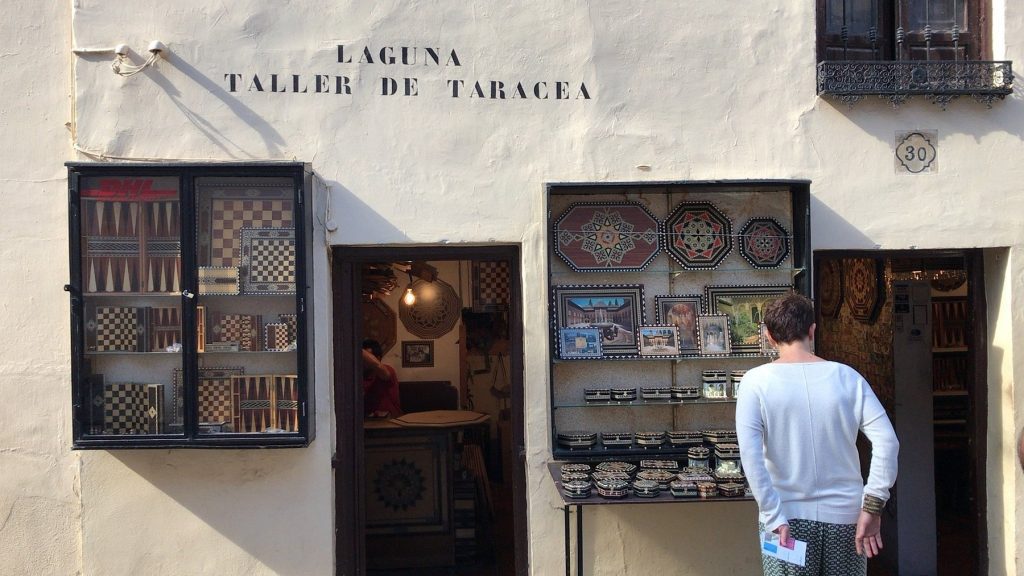
The art of traditional wood inlay at Laguna Taracea
Exterior of Laguna Taracea, a traditional wood inlay workshop near the Alhambra. / DABOCHAN
Taracea is another traditional craft inherited from Al-Andalus. It’s a decorative woodworking technique that involves combining and inlaying small pieces of different materials, such as woods of varying shades, bone, ivory, mother-of-pearl or metals, to create ornamental patterns.
In fact, the technique of decorating wooden surfaces with inlays dates back to ancient civilizations, particularly Egypt and Mesopotamia, more than 4,000 years ago. Later developed in the Islamic world, it reached Al-Andalus, where it was already documented in 10th-century Caliphal Córdoba. For example, although it has not survived, historical records tell us that the minbar commissioned by Caliph Al-Hakam II for the Great Mosque of Córdoba was made using this technique.
However, it was in Nasrid Granada during the 14th and 15th centuries that Islamic geometric wood inlay reached one of its greatest periods of splendor in the Iberian Peninsula, becoming one of the city’s most characteristic crafts, a tradition that remains alive in Granada today.
The Alhambra Museum preserves several pieces of Nasrid inlaid furniture that were used in the palace. The so-called jamuga is perhaps the most spectacular and famous example: a folding X-frame chair, considered one of the possible throne chairs of the Nasrid sultans from the time of Muhammad V onward, around 1380.
And there are also extraordinary chessboards, caskets, chests and jewelry boxes…
In Granada today, it’s common to find many objects featuring this type of decoration in handicraft shops. For example, in the shops near Plaza Bib-Rambla or around the Alcaicería (the former silk market, now an area of souvenir and handicraft shops near the Cathedral). However, if there’s one place that’s really worth visiting, it’s Laguna Taracea.
This is one of Granada’s historic workshops, specializing entirely in this craft since 1877. Here, the artisans — and you can watch them at work — continue to use traditional techniques, materials and tools associated with 14th-century Nasrid wood inlay.
With these, they make boxes, chests, tables, chairs, game boards and other furniture, both historical reproductions and their own creations.
Another of Laguna Taracea’s distinctive features is that its workshop is located within the medina of the Alhambra. Could there be a better way to immerse yourself in Nasrid Granada?
Dimana: Calle Real de la Alhambra, 30.
These experiences are spectacular, but there’s more. Accompanied by one of our local Muslim guides, you can discover other places where you’ll enjoy a genuine historical and multisensory immersion in Al-Andalus and Nasrid Granada. Are you in?
Jelajahi wilayah yang kaya akan warisan Islam, alam yang memukau, dan pengalaman unik yang cocok untuk keluarga. Sebuah permata tersembunyi bagi para pelancong Muslim.