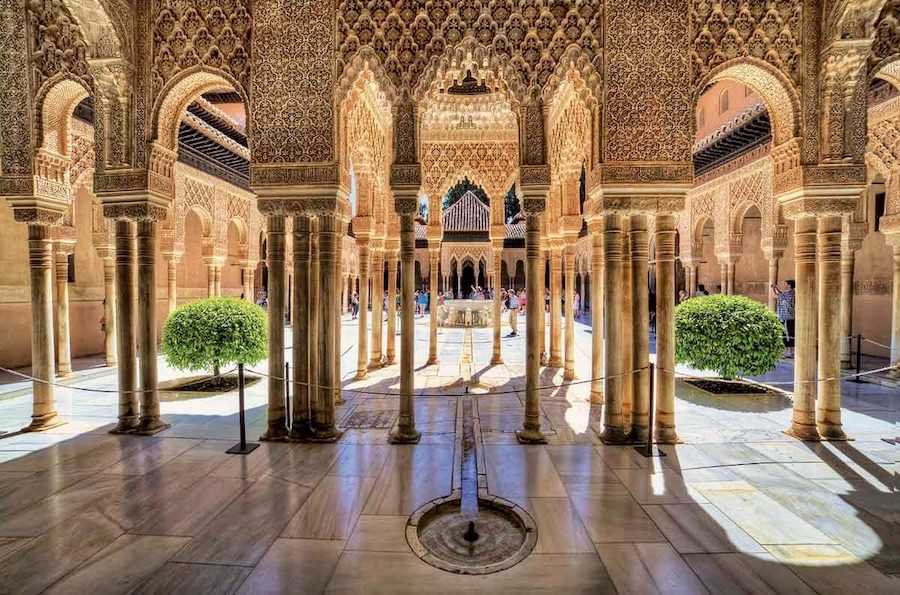
A young Muslim tourist visiting the Palace of the Lions at the Alhambra / LET'S GO HALAL
The Alhambra stirs deep emotions. Declared a UNESCO World Heritage Site in 1984, it is Spain’s second most visited monument, after Barcelona’s Sagrada Família, and one of the world’s most celebrated masterpieces of Islamic architecture. It is also a place unlike any other: an Islamic palatine city that has survived from the Middle Ages in a remarkably complete state.
There are many reasons why the Alhambra في غرناطة is such a captivating and magical place. Its beauty, harmony, and architectural balance make it a true masterpiece, not only of Islamic art but of world heritage. Yet these are not the only reasons. Some of the Alhambra’s wonders hold meanings, messages, and symbols deeply rooted in Islam, which can make visiting it a particularly moving experience for Muslim travelers.
Here, we’ll share some of the wonders that will take your breath away during your visit to the Alhambra, and that an expert Muslim guide can help you understand and appreciate in a very special way.
Why was the Alhambra built on the Sabika hill?
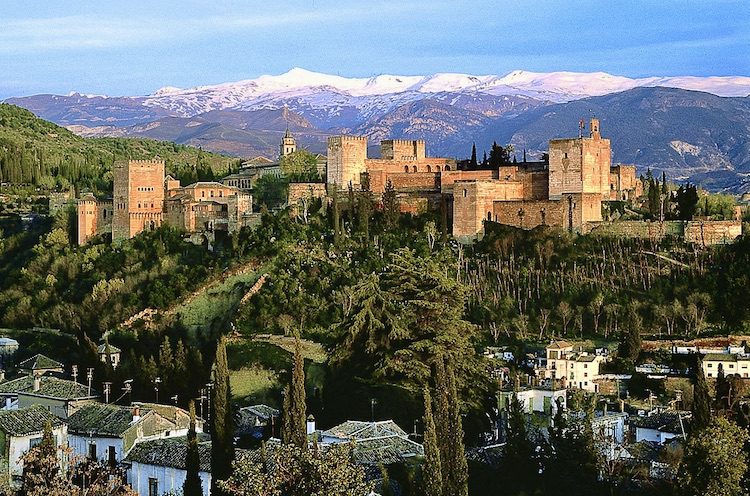
The Alhambra, built on Sabika Hill, with the Sierra Nevada mountains in the background. / SHUTERSTOCK
Muhammad I, also known as Ibn al-Ahmar, founder of the Nasrid dynasty, made a bold and strategic decision. In 1238, he chose the Sabika hill, overlooking Granada, as the site for his new seat of power, moving the royal court from the old Alcazaba in the Albaicín, known as the Alcazaba Qadima or “Old Alcazaba,” which had been the center of power of the previous Zirid dynasty.
The Sabika hill already had ancient defensive structures and offered an ideal location: elevated, easily defensible, and with commanding views over Granada. Just as importantly, its proximity to the Darro River made it possible to secure a reliable water supply. The hill also provided a wide, largely unoccupied space, ideal for new buildings and orchards that could help supply the city.
Muhammad I took a bold step, and he was right. He became the first of 24 Nasrid rulers who would make the Alhambra their royal residence.
Today, however, the Alhambra has a different kind of “sultan”: its beloved resident cats. More than 60 were recorded in 2023, some bearing names inspired by the Alhambra’s Nasrid past, such as Boabdil, Aixa, and Yusuf. They help keep rodents under control and are part of the Alhambra’s ecosystem, where around 130 animal species have been recorded. The cats are cared for through a program run in collaboration with animal welfare organizations. All are microchipped, registered, and have designated feeding stations.
You can learn more about the strategic reasons behind the Alhambra’s location by visiting it with an expert Muslim guide.
Why is it called the Alhambra?
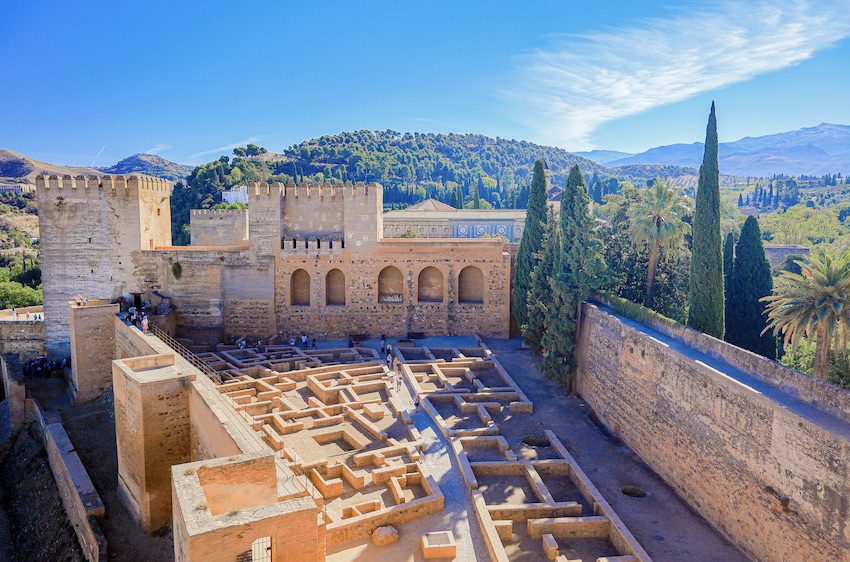
The Alhambra’s reddish color is visible in some areas, such as here in the Alcazaba. / DAVID CERINI – UNSPLASH
Alhambra comes from the Arabic al-Hamrā, meaning “the Red One.” The name is traditionally associated with al-Qal‘a al-Hamrā, or “the Red Fortress.” But why the reference to that color?
There are several theories. Some link the name to the reddish color of the clay on the Sabika hill, which was used as a building material. Others associate it with the nickname of Muhammad I, Ibn al-Ahmar (“son of the Red One”), traditionally linked to the reddish hair of one of his ancestors. However, references to a fortress called Alhambra predate the Nasrid dynasty, making this explanation historically unlikely.
Another, more legendary explanation suggests that the name came from the reddish glow of torches illuminating the fortress during nighttime construction, as such an enormous undertaking left little time for rest. In fact, in the Alcazaba, the oldest surviving part of the Nasrid Alhambra, you can still see areas with distinctly reddish bricks and building materials.
Discover more fascinating stories behind the Alhambra with one of our expert Muslim guides.
Fortress, palace, city… What exactly is the Alhambra?
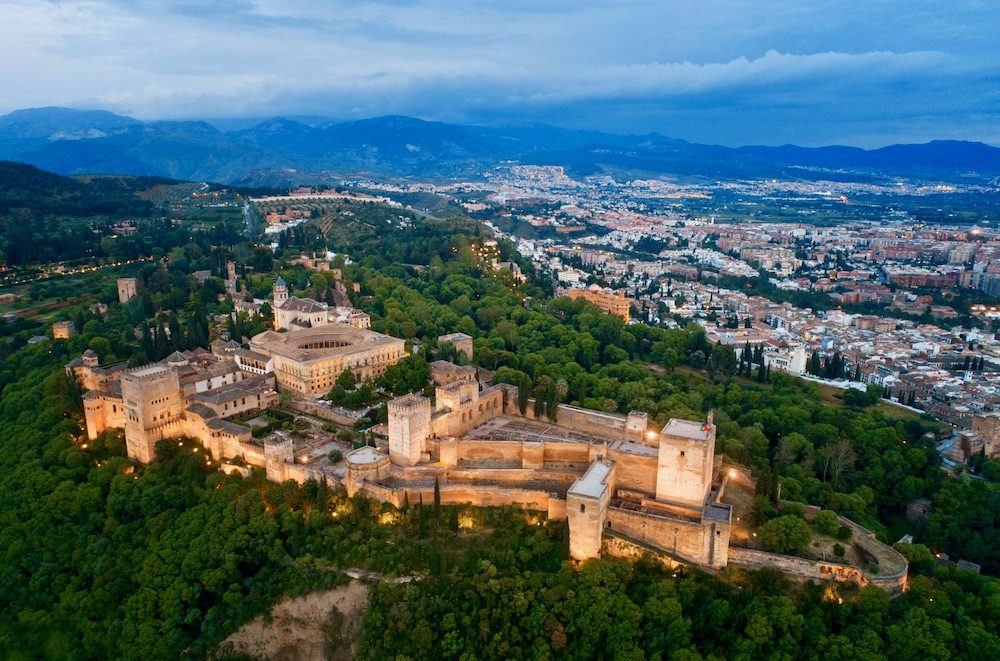
Aerial view of the Alhambra palace complex, with Granada in the background. / SHUTTERSTOCK
The earliest documented fortifications on the Sabika hill, where the Alhambra now stands, date back to the 9th century. Their purpose was defensive. In 1238, Muhammad I began building a new fortress, the Alcazaba, the oldest surviving part of the Nasrid Alhambra. But his purpose, as we have already seen, was much more ambitious: he wanted to turn this place into the center of his power and the residence of his court, leaving behind its former location in the Albaicín. (Albaicín is also the name of a hill and Granada’s oldest historic neighborhood, closely linked to the origins of the city. Since 1994, the Albaicín has also been part of a UNESCO World Heritage Site and is a place you shouldn’t miss).
Thus, the Alhambra was conceived and designed as an independent city, structured into different areas, each with a specific and well-defined purpose. It is a palatine city whose planning and construction spanned more than two centuries. It reached its peak in the second half of the 14th century, during the reigns of Yusuf I (1333–1353) and Muhammad V (1353–1391). In 1492, the last Nasrid king, Abu Abd Allah Muhammad XII, also known as Boabdil, surrendered Granada to the Catholic Monarchs (Isabella of Castile and Ferdinand of Aragon), marking the end of the last Islamic kingdom in the Iberian Peninsula.
With one of our expert Muslim guides, you’ll learn more about the Nasrid sultans and the wonders that have made the Alhambra a UNESCO World Heritage Site since 1984.
What areas should you visit in the Alhambra?
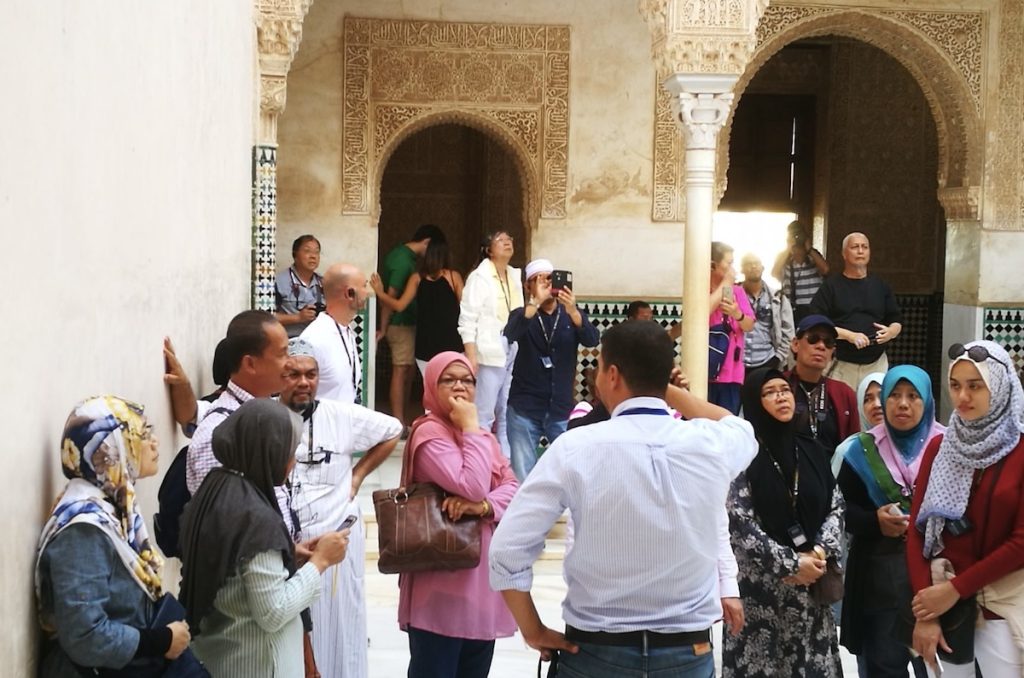
A group of Muslim travelers listening attentively to their guide at the Alhambra. / LET’S GO HALAL
The Nasrid Palaces are the artistic highlight and the most important and iconic part of this palatine city, but there are other fascinating areas you should visit to gain a complete picture of this extraordinary monument, one that will stay in your memory forever.
At the top of the Sabika hill stands the Alcazaba, the military zone. From here, the city was designed as a walled and heavily fortified space, with numerous watchtowers and five main entrance gates. This is where the elite guard serving the sultan lived.
The Medina, or citadel, was the service area for the Nasrid Palaces. It was organized along a main road, the Calle Real, which extended from the Puerta del Vino (the Wine Gate, whose name dates from Christian times and is traditionally associated with the storage of wine in this area) to the area known as the Secano, where today you’ll find the Parador de Turismo, a magnificent state-owned hotel. Originally, the Medina included public buildings such as a mosque and public baths, as well as spaces for commerce, industry, and crafts. The Acequia Real, a canal more than six kilometers long, brought water from the Darro River and supplied the entire walled complex.
Along the northern flank of the hill, over a period of more than two centuries, the palatial area of the Nasrid city was built: the Nasrid Palaces, where the sultans of Granada lived and received visitors. The itinerary begins at the Mexuar (from the Arabic Maswar), where the Shura, or Council of Ministers, met and where the sultan also administered justice.
Next comes the Palace of Comares, or Palace of the Myrtles, with the Comares Tower, the tallest in the Alhambra at 45 meters. Inside is the largest room in the complex: the Hall of Comares, also known as the Hall of the Ambassadors or Throne Room, one of the most impressive spaces for its ceiling and Arabic inscriptions.
Then comes the Palace of the Lions, considered the pinnacle of Nasrid art. Highlights include the famous courtyard with its fountain of twelve lions, the Hall of the Kings, the Hall of the Abencerrajes, and the Hall of the Two Sisters, with its magnificent muqarnas dome, often interpreted as a representation of the heavens. Finally, the small Partal Palace, with its gardens, pool, and oratory, was a space dedicated to family life and meditation, away from the formalities of the court. And it holds a fascinating curiosity: the nearby Houses of the Partal preserve the only surviving examples of Nasrid figurative mural paintings in the Alhambra.
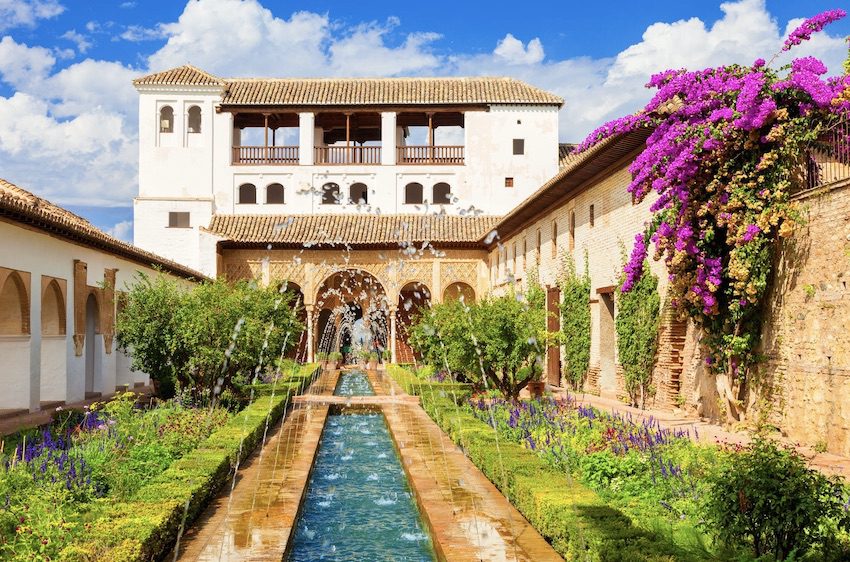
The Court of the Water Channel at the Generalife Palace, part of the Alhambra complex. / ISTOCK PHOTO
The Generalife is also part of the monumental complex. Its name comes from Yannat al-Arif, or “Garden of the Architect.” It has its own palace, Dar al-Mamlaka al-Sa’ida, or the Royal House of Happiness, a name given by the poet and vizier Ibn al-Jayyab. Outside the original walls, this area includes a palace, courtyards, ornamental gardens, and orchards where the sultans would stay with their families during the hottest months. These orchards, covering around seven hectares, have preserved traditional agricultural practices passed down since the Middle Ages. Originally, the Generalife was a separate estate from the Alhambra. During the 20th century, new gardens and pathways, including the Rose Garden, helped integrate the two into the monumental complex visitors explore today.
And finally, the Palace of Charles V, commissioned by the king and emperor, grandson of the Catholic Monarchs. This Renaissance building would forever alter the harmony of the Islamic complex. Construction work was underway by 1533, but the palace remained unfinished through successive reigns. It was finally completed in the 20th century and today houses the Alhambra Museum.
An important tip for a hassle-free trip to Spain: When buying a ticket or booking a guided tour of the Alhambra, make sure it includes access to the Nasrid Palaces. There are different types of tickets and guided tours, and not all include them. On our tours with expert Muslim guides, you’ll enjoy a unique and, of course, complete experience.
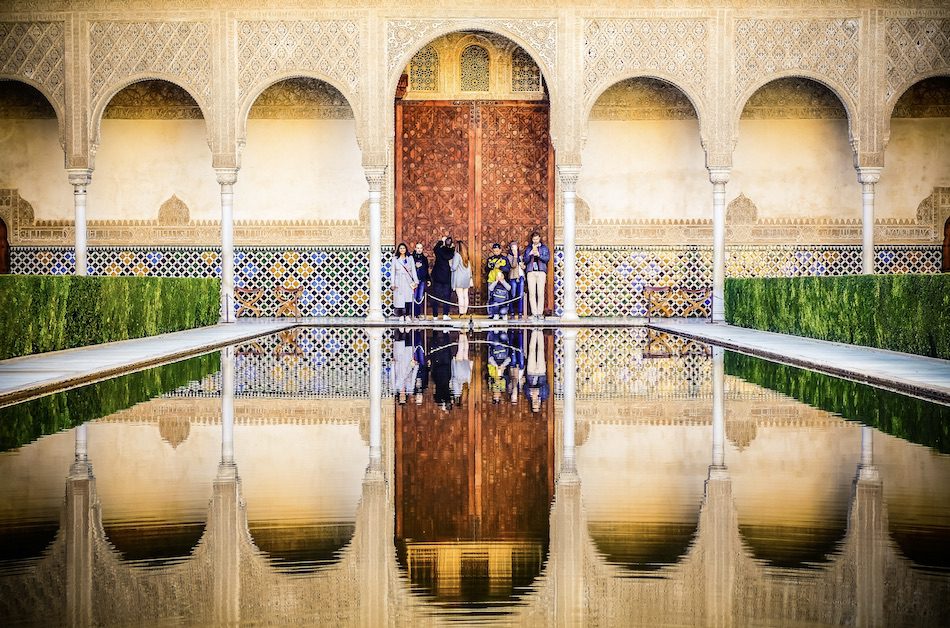
The central reflecting pool in the Court of the Myrtles, at the Palace of Comares in the Alhambra. / HARI NANDAKUMAR – UNSPLASH
Water plays a fundamental role in the Alhambra and is one of its greatest treasures. Not only because Nasrid engineers masterfully managed to capture and raise water to irrigate and transform a rocky hill into a true garden paradise. They achieved this by building a canal more than six kilometers long to bring water to the site, complemented by ingenious hydraulic systems to raise and distribute it.
In the palatine city, every drop of water was used wisely and cherished as a true treasure. Nothing like those famous gargoyles so common on Christian buildings, where water is forcefully expelled…
It’s hard to walk through the Alhambra without coming across a pool or fountain where water takes center stage. The fountains of the Alhambra aren’t mere decorative features. They are part of the architecture of its palaces, of the spirit of beauty that permeates everything. In fact, the Nasrids didn’t stop at building fountains in courtyards and gardens. They also brought water into the main interior spaces, through narrow channels where it flowed gently, almost whispering as it went.
One of their most beautiful and distinctive techniques was creating thin sheets of water in shallow pools that acted as mirrors, reflecting architectural elements and producing a magical effect that amplified their beauty. Almost like having two palaces in one… The pool in the Court of the Myrtles, just over 30 meters long, is one of the most celebrated examples of this “mirror effect.” Many visitors try to capture this beautiful reflection with their cameras.
Water also carries deep symbolism in Islam, representing life, abundance, wealth, power, and eternity. The Holy Quran evokes Paradise through images of lush gardens, shade, and flowing rivers. And it is difficult not to recognize something of that vision in the Alhambra, where water, gardens, and architecture come together to create an extraordinary sense of harmony and beauty.
You can discover more about the wonders of water in the Alhambra with one of our specialized guided tours.
The mathematics hidden in the Alhambra
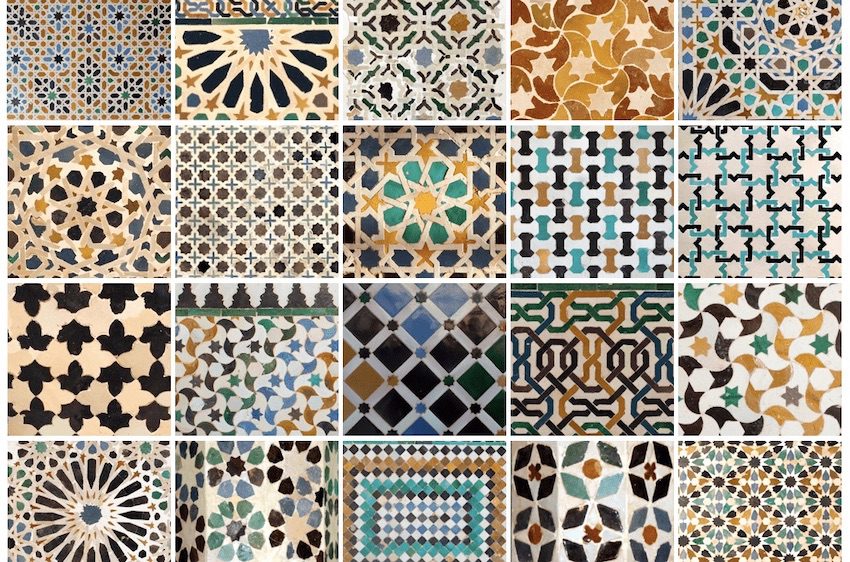
Examples of geometric patterns found in the mosaics decorating the walls of the Alhambra. / PATRONATO DE LA ALHAMBRA
Did you know that the Alhambra is considered the only ancient monument in the world to feature all 17 plane crystallographic groups? These groups, also known as wallpaper groups, represent all the possible ways geometric patterns can repeat across a flat surface.
According to the Alhambra’s own governing institution, the Nasrid artisans achieved all 17 types of symmetry in their extraordinary decorative designs, a singular achievement also explored in a 2025 mathematical study published by the European Mathematical Society. And what makes this even more remarkable is that these patterns were created centuries before the Russian mathematician Evgraf Fedorov established the mathematical classification of the 17 groups in 1891.
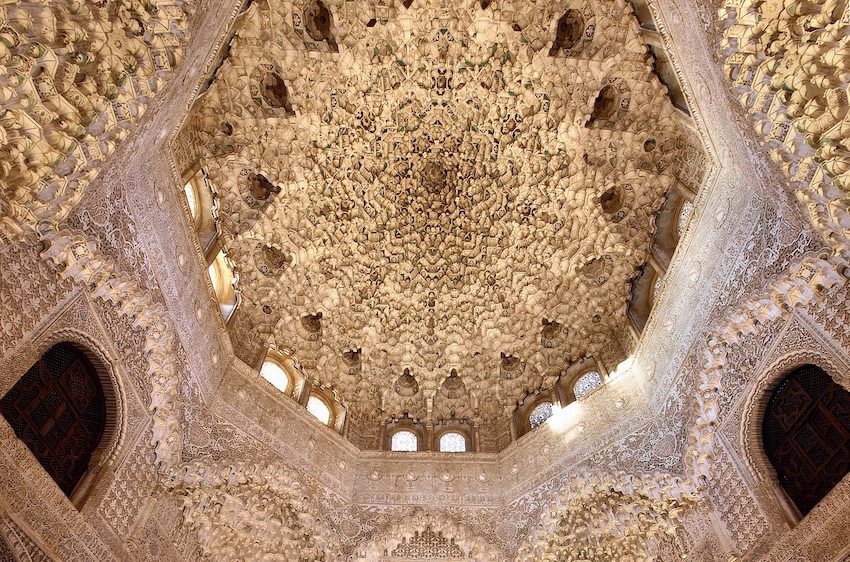
Another decorative element that draws visitors’ attention is the use of muqarnas, built from small geometric elements arranged together to create intricate, three-dimensional forms that appear to hang from ceilings and arches. Although the muqarnas of the Alhambra resemble those found elsewhere in the Islamic world, their construction techniques and geometric arrangements have distinctive characteristics.
From mosaics, vaults, and arches to the floor plans of buildings and the arrangement of spaces, geometry is everywhere in the Alhambra. Nasrid artisans used sophisticated principles of symmetry and proportion to create intricate geometric patterns full of beauty and meaning.
The spirituality and symbolism of the Alhambra
The impressive muqarnas dome in the Hall of the Two Sisters at the Alhambra. / TURISMO DE GRANADA
The Alhambra is an expression of Islamic architecture of power, where the presence and magnificence of Allah are reflected throughout the building, in every corner and architectural detail. Geometry, through its endless repetition of patterns, plays a fundamental role in expressing this idea, also evoking the concept of infinity.
Through geometry, Andalusi artists not only created visual beauty but also conveyed a cosmological vision: a universe structured and governed by universal laws.
In some mosaics, for example, the artists represented the stars of the heavens, arranging them in rotating patterns to evoke the endless succession of day and night.
The muqarnas that fill and hang from the spectacular dome in the Hall of the Two Sisters evoke the Universe and Creation, with Allah, One and indivisible, at the center of everything. In the Throne Room, the largest and most richly decorated hall of the monument, where the sultan received his guests, the astonishing wooden ceiling is traditionally interpreted as a representation of the Seven Heavens described in the Holy Quran.
This spiritual vision is also reflected in the Alhambra’s gardens and its extraordinary use of water. The Holy Quran describes Paradise as a place of lush gardens, shade, and flowing rivers, images that find a beautiful echo in the Alhambra. Its fountains, pools, and gardens evoke something of that vision of Paradise, where nature, beauty, and harmony come together.
One of the most powerful expressions of this spiritual dimension is also the most frequently repeated inscription in the Alhambra: Wa-lā ghālib illā Allāh (لا غالب إلا الله), meaning “There is no victor but Allah.” It was the motto of the Nasrid dynasty, a declaration of royal authority that also carried a profound Islamic message: however powerful a ruler might be, ultimate victory and power belong to Allah alone. The words appear again and again throughout the palaces, carved into walls, columns, and decorative elements.
The presence of the Holy Quran is equally significant. Its verses are inscribed in different parts of the Alhambra, sometimes alongside invocations, praises to Allah, and expressions of royal power. In the Tower of the Captive, for example, inscriptions include Surah Al-Ikhlas (112), which proclaims the absolute Oneness of Allah, and Surah Al-Falaq (113), a prayer seeking His protection. Of course, these are not simply ornamental texts: their words form part of the spiritual meaning of the spaces they inhabit, a heritage you can still discover and admire in the Alhambra today.
Read, listen to, and feel the Alhambra
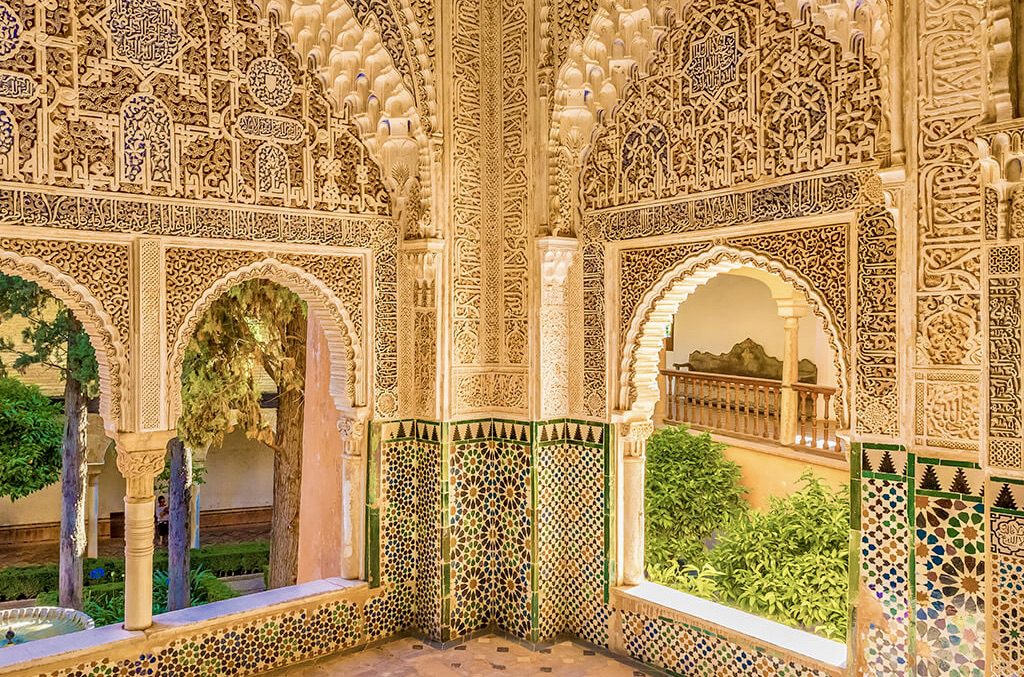
Arabic inscriptions at the Lindaraja Viewpoint in the Alhambra. / SHUTTERSTOCK
Visiting the Alhambra means stepping into one of the most extraordinary and beautiful examples of architecture made of words.
The visual beauty and meaning of its devotional, Quranic, and royal inscriptions, written in different Kufic and cursive styles, together with its mural poetry and calligrams, turn the monument into a magnificent three-dimensional manuscript. One that enters into dialogue with water, gardens, and the surrounding landscape, bringing its buildings to life with the vibrant, musical rhythm of Arabic poetry and language.
The walls of the Alhambra are the pages of an open book, waiting to be read and understood.
The monument conceals nearly 10,000 inscriptions among its walls, arches, and doorways. Until relatively recently, much of their meaning remained poorly understood. Thanks to extensive research and digital cataloging, scholars have been able to study and interpret this extraordinary written heritage in much greater depth.
The Alhambra is a palace-poem unlike any other in the world. But to read and understand it, you need to know Arabic. One of our expert Arabic-speaking guides can help you discover the meaning of its inscriptions and appreciate the poetry that brings its walls to life.
Bioclimatic, earthquake-resistant, and sustainable architecture
The Palace of the Lions, an example of bioclimatic architecture at the Alhambra. / ISTOCK PHOTO
As if beauty, harmony, and spiritual meaning were not already enough reasons to admire the Alhambra, there are other remarkable features that make this monument especially impressive from today’s perspective: it is an outstanding example of sustainable construction, brilliantly integrating bioclimatic architectural solutions.
In the Court of the Lions, you can observe some curious lead discs between the different sections of the columns. These metal elements helped the structural components fit together properly, improving their stability, and may also have contributed to their resistance during earthquakes. The Alhambra has survived centuries of seismic activity in Granada, a remarkable achievement considering the materials and construction techniques used.
And what about relief from the summer heat? On days when outdoor temperatures approach 40°C (104°F), some rooms inside the Alhambra can remain around 25°C (77°F). Water and vegetation help cool the air, which circulates through carefully designed courtyards to reach the interior rooms.
The orientation of the buildings was also carefully considered. In summer, rooms located on the northern side were particularly suitable, with small windows and walls more than two meters thick in some cases, helping to maintain cooler indoor temperatures. Lantern-style ceilings, with openings at the top to release hot air, also acted as a form of natural air conditioning.
The Alhambra is an oasis of beauty and marvels in every sense. Be honest: aren’t you eager to visit it? Or, if you’ve already been there, to experience it once again with all these fascinating details in mind?