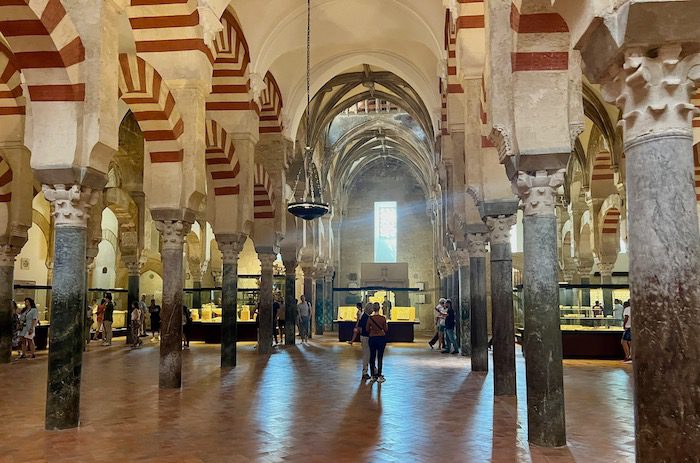
General view of the Great Mosque of Córdoba / ISTOCK PHOTO
Every year, the Great Mosque of Cordoba attracts more than two and a half million visitors. It is the most important Islamic monument in the West and, without a doubt, one of the most beautiful mosques in the world. It is also one of the greatest artistic achievements of Al-Andalus and one of the most recognizable symbols of its extraordinary legacy. The history of the Great Mosque of Cordoba is inseparable from the history of Al-Andalus itself.
Today, most of its visitors are not Muslim. But when they are… Oh, the emotion! It is almost impossible to describe. In more than twelve years of experience providing travel services and assisting Muslim travelers in Spain, we have even seen some of them moved to tears. Words alone cannot do it justice. We certainly encourage you to visit the Great Mosque of Cordoba if you have not already done so. And to visit knowing how and where to look, so you can enjoy the experience even more and uncover the profound meanings held within this astonishing monument, recognized as a UNESCO World Heritage Site in 1984.
There is no better way to make the most of the experience than to hire a Muslim guide. Someone who can offer you a truly coherent, rigorous, inspiring account, free from distorted narratives. Choosing the right guide in advance is well worth including in your travel preparations.
To whet your appetite—and leave you in no doubt that قرطبة and its Great Mosque deserve a place near the top of your travel wish list—we are going to explore its main features, its technical and artistic achievements, and its deeper meanings.
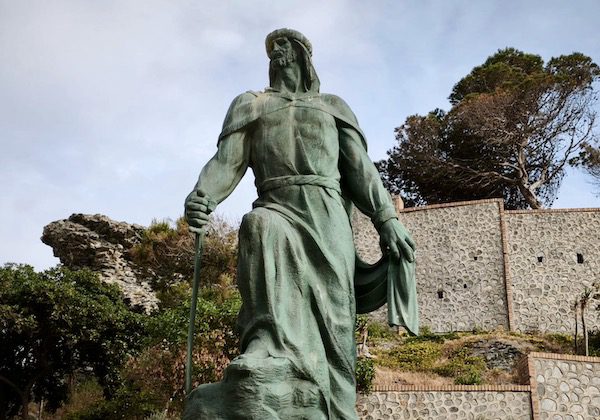
But we must start at the beginning. In 755, Abd al-Rahman I, known as the Exile, landed at Almuñecar, in غرناطة. An Umayyad prince, he was one of the few survivors of the ruling dynasty that had governed the Islamic world from Damascus, then one of its most important cities. He had been forced to flee the East to save his life after the Abbasids came to power. In 756, he would establish the independent Emirate of Cordoba, and around 785–786 he began building a great congregational mosque in its capital. With successive expansions, that mosque would become one of the largest in the Islamic world and the foremost in the West.
Statue of Abd al-Rahman I, founder of the Great Mosque of Cordoba, in Almuñecar, Granada. / TURISMO DE ALMUÑÉCAR
But this is only part of its fascinating history. There is so much more to discover about the Great Mosque of Cordoba than we could possibly cover in a single article. That is why we have decided to explore its many wonders in a series of articles, each focusing on different aspects: its architectural innovations, the original mosque and its successive expansions, its artistic highlights, the cultures that inspired its architecture, how a cathedral came to be built within it…
In this first part, we will focus on its origins and some of its most distinctive features: the famous forest of columns, its red-and-white arches… Let’s begin!
What was there before the Great Mosque?
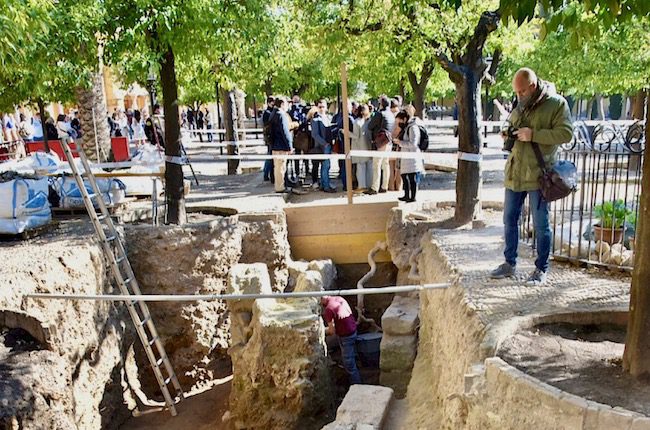
Archaeological excavations in the courtyard of the Great Mosque of Cordoba. / MEZQUITA-CATEDRAL DEL CÓRDOBA
One of the first questions that comes to mind is also one of the hardest to answer—and one of the most controversial.
Archaeologists, and, quite strikingly, the Catholic Church, which has funded some of the more recent research, have continued trying to establish what stood here before the Mosque of Cordoba was built. A Visigothic church or basilica? An episcopal complex? Remains of Roman Cordoba? Experts have long struggled to answer these questions. Excavating beneath the mosque is extremely difficult, although excavations have taken place. And even when researchers dig and discover what lies below, the findings sometimes raise almost more questions than answers.
Among the remains visitors can see are mosaics in an archaeological area below floor level, protected and accompanied by signs linking them to the Church of San Vicente. The interpretation of these remains, and their attribution to a Christian place of worship predating the mosque, have been debated by specialists. As historian Alejandro García Sanjuán explains: “Obviously, the existence of mosaics is not sufficient grounds for making a serious archaeological case for the existence of a Christian place of worship.”
One of the best-known historical accounts of the mosque’s origins comes from a tradition transmitted by the Cordoban chronicler Ahmad al-Razi, who wrote more than a century after construction began. The account bears striking similarities to the story of the founding of the Great Umayyad Mosque of Damascus: there was supposedly a church on the site, which Muslims and Christians shared for worship after the Muslim conquest, until the Umayyad ruler eventually compensated the Christians to gain possession of the entire site and build the mosque.
This similarity has led some historians to suggest that the Cordoban account is essentially just that—a “narrative” that may have served to establish dynastic continuity and legitimacy through a symbolic connection with Damascus.
The truth is that research continues today, and what exactly lies beneath the Great Mosque of Cordoba remains unclear.
Why is it described as a “forest of columns”?
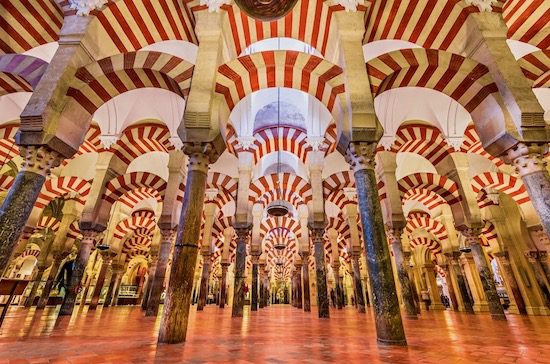
The so-called “forest of columns” inside the Great Mosque of Cordoba. / ISTOCK PHOTO
The best way to answer that question is to stand somewhere in the middle of the mosque, surrounded by arches and columns. You lose the sense of being inside a hall, a space with clearly defined boundaries, and instead feel as though you really are in something resembling a forest. The impression of infinity stretches out all around you.
It is difficult to pinpoint the origin of the expression “forest of columns,” although we know that travelers in the nineteenth century were already comparing the mosque’s interior to a forest. The image caught on and has become one of the most frequently repeated descriptions of the wonders of the Mosque of Cordoba.
And how many columns does the mosque have? That is another question many curious visitors ask when they find themselves overwhelmed by this forest. How many columns are there? Well, it is striking that, at a time when some people have their sights set on Mars, no consensus has yet been reached on how many columns the Mosque of Cordoba actually has.
The figure of 856 columns is commonly accepted—and repeated—as a standard reference, although some guides at the monument have counted them themselves and insist that the total does not exceed 700.
For a time, one of the legends surrounding the mosque even claimed the rather absurd figure of 365 columns, one for every day of the year… Quite apart from the fact that a quick visual count is enough to disprove it, did nobody stop to think that the Islamic calendar—the calendar of the mosque’s builders—has not 365 days, but 354 or 355?
It is also said that the mosque once had more than 1,000 columns, or even 1,300… Perhaps this lack of consensus comes down to uncertainty about what, exactly, is being counted. Structural or decorative columns? Visible or concealed? Those in the courtyard or those inside? Are we talking about all the columns that existed before a substantial number (estimated at around 63) were removed to make room for the cathedral that now stands within the building?
In any case, our main conclusion is this: the number of columns is a detail of no real importance.
Are some columns Roman and Visigothic?
In the foreground, reused Roman columns and capitals inside the mosque. / WIKIMEDIA COMONS
That’s right. The columns of the original mosque, built by Abd al-Rahman I beginning in 785, came from earlier Roman and Visigothic buildings. It was during later expansions that pieces made specifically for the mosque began to be used as well. The ninth-century expansion under Abd al-Rahman II included some newly made capitals, but it was not until the tenth century, with the expansion undertaken by Al-Hakam II, that the use of shafts and capitals manufactured specifically for its construction became widespread.
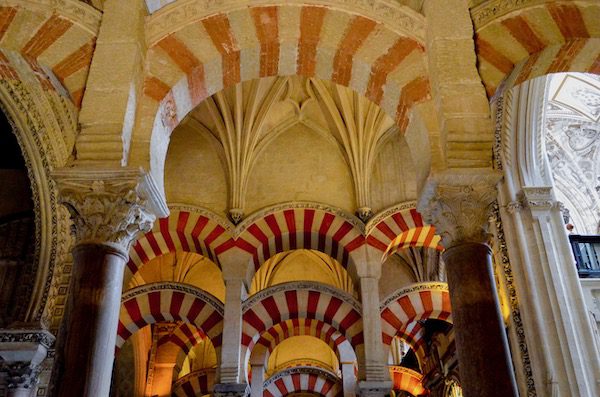
When you visit the mosque, take a close look at the column capitals. If you see capitals with a wide variety of shapes and styles, you are probably in the oldest part of the mosque, built by Abd al-Rahman I, where Roman and Visigothic pieces were reused. If, on the other hand, you notice more uniform, simplified capitals with stylized leaf forms—known as pencas capitals—you are looking at columns and capitals made expressly for the mosque, following models developed within Cordoban Islamic art. Their use became widespread from the tenth century onward, with Al-Hakam II’s expansion.
Rows of columns with Caliphal ‘pencas’ capitals, made specifically for the Great Mosque of Cordoba. / WIKIMEDIA COMONS
The reuse of architectural and sculptural materials from earlier buildings was common practice from Antiquity through the early modern period. Specialists refer to these reused elements as “spolia” and explain that the practice had several motivations. Some were economic: the availability of materials or the need to save time. Others were ideological, symbolic, or even aesthetic. Reusing pieces from classical Rome or an earlier empire, for example, allowed new rulers—Christian emperors, Visigothic kingdoms, or medieval religious institutions—to associate themselves with the grandeur, authority, and memory of a prestigious past.
Art historians and archaeologists interpret the use of spolia in the Mosque of Córdoba not merely as recycling out of necessity—reflecting Abd al-Rahman I’s desire to build a great congregational mosque in a relatively short time—but also as a possible means of political and symbolic legitimization. By incorporating Roman and Visigothic shafts and capitals, the Umayyads could appropriate the prestige of Antiquity and project an image of power and historical continuity in Al-Andalus. The practice could also express the supremacy of the new Islamic power over those that preceded it.
And perhaps there was nostalgia, too: the Cordoban Umayyads revived a practice their dynasty had already employed in the East, specifically at the Great Umayyad Mosque of Damascus, where Roman and Byzantine architectural elements were also reused.
Why does the mosque have double arches?
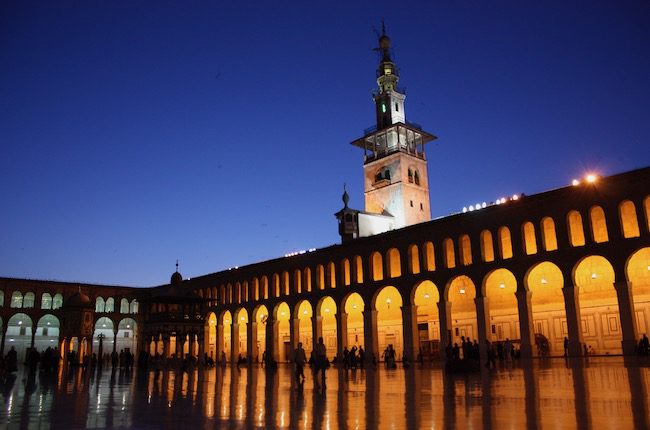
Double arches of the Umayyad Mosque of Damascus, a possible source of inspiration for the Great Mosque of Cordoba. / WIKIMEDIA COMONS
The double arches are among the mosque’s most admired architectural achievements. For one thing, they lend the building a remarkable visual lightness and help create that feeling of being in a “forest.” But above all, they solved a practical problem.
Many of the columns used in the mosque’s earliest phase were taken from older buildings and differed considerably from one another. It is almost difficult to find two identical columns. Beyond these differences, however, their limited height—barely three meters, or about ten feet—presented a particular challenge. A roof resting directly on them would have produced a low, dark, oppressive space and raised serious stability concerns because of the weight of the roof.
The double arches made it possible to create a spacious, lofty interior while providing stability. The lower horseshoe arches do not directly support the roof; instead, they act as structural braces—a system architects call “entibo”—helping prevent the supports from spreading or shifting. The upper semicircular arches carry the loads of the structure above them and help support the roof.
The differences in column height were addressed by adjusting their points of support. A base could be added beneath a shorter column. Other shafts rested directly on the floor and could even be sunk slightly into it when necessary. If small differences in height remained, they were compensated for by adjusting the upper piers—the elements rising above the capitals on which the second tier of arches rests—by a few centimeters. In this way, the builders achieved a level roof despite the variety of reused pieces.
This solution of superimposed arcades had precedents at the Great Umayyad Mosque of Damascus, although the technical arrangement was different. There, a second tier of smaller arches, arranged in pairs, rises above the large lower semicircular arches. In Cordoba, by contrast, the lower horseshoe arches and upper semicircular arches span the same supports, leaving the space between the two levels open.
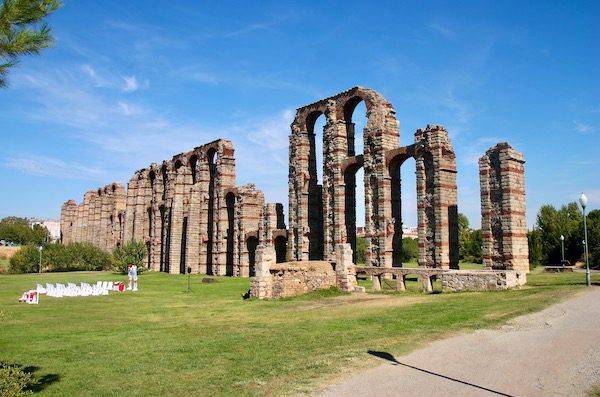
As specialists explain, everything suggests that Abd al-Rahman I’s architects drew on different building traditions: the monumental Umayyad architecture of the East and the engineering solutions found in Roman aqueducts in Hispania. One aqueduct in particular is often cited: Los Milagros in Mérida. There, too, intermediate arches brace the piers. And there is another coincidence: the Los Milagros aqueduct is also two-toned, combining the deep red of brick with gray granite… In art, as in history, it is not always easy to draw clear boundaries between precedents and influences.
The horseshoe arch, often regarded as one of the most characteristic features of the art of Al-Andalus, has precedents in local Visigothic buildings, but it can also be found in pre-Islamic structures in the Near East.
Why are the mosque’s arches two-toned?
The Roman aqueduct of Mérida, one of the possible sources of inspiration for the Great Mosque of Cordoba. / WIKIMEDIA COMONS
The mosque’s distinctive two-toned arches owe their appearance to the alternating use of two different materials for their voussoirs (the pieces that form an arch): red brick and yellowish or white limestone. The result is one of the Great Mosque of Cordoba’s most recognizable visual features. Interestingly, some later expansions achieved the same two-toned effect in a different way: by painting certain stone voussoirs red to reproduce the original alternation. The combination of colors had already become one of the defining features of the Great Mosque of Cordoba and of Cordoban caliphal architecture.
But here again, we find possible connections with the Eastern architecture Abd al-Rahman I had known before arriving in Al-Andalus. Arabic has a word, ablaq (أبلق), for a decorative technique based on alternating materials of different colors, usually light and dark stone. This tradition became highly developed in the Islamic architecture of the Near East, particularly in Syria and Egypt, although its origins predate Islam.
One of its earliest examples can be found in the Dome of the Rock in Jerusalem, built by the Umayyads in the late seventh century, where arches feature voussoirs in alternating colors. The dating of some of these elements remains a matter of debate, but their similarities to Córdoba are especially intriguing given the Umayyad dynasty’s Eastern origins.
And we should not forget the other precedent we have already mentioned: the Roman aqueduct of Los Milagros in Mérida, where red brick and gray granite also create a striking two-toned effect.
Once again, the Great Mosque of Cordoba reminds us just how much architectural history is shaped by encounters, adaptations, and influences that cannot always be traced with precision.
Keep discovering the Great Mosque of Cordoba
There are many more wonders, precedents, and stories of the Great Mosque of Cordoba we could share with you, but this article is already longer than is advisable.
We invite you to follow the next parts in this series, where we will continue exploring some of the most fascinating aspects of this extraordinary monument. Or, better still, to visit the Great Mosque of Córdoba with one of our specialized Muslim guides, who will help you discover and understand it from a unique perspective.