Abbas Ibn Firnas and his flying device at the Almazara El Toro Museum in Ronda (Málaga). / ALMAZARA EL TORO
We invite you on a journey through the great scholars, scientists, and other brilliant personalities of Al-Andalus. A journey through the great names who helped Islamic Spain reach the heights of knowledge and made it one of the most flourishing places in Europe during the Middle Ages. A journey we invite you to take not only through memory and words, but also by exploring the streets and places that still commemorate these great figures in a tangible way.
Because when you stroll through قرطبة, for example, you can experience the grandeur of Islamic Qurtuba by visiting, of course, the impressive Great Mosque, the remains of the palatial city of Medina Azahara, and the streets of the old medina… But you can also recognize that grandeur in the more modest monuments honoring figures such as Abbas Ibn Firnas, a pioneer of aviation; Ibn Rushd, the physician and philosopher; or Caliph Al-Hakam II, who turned the library of Córdoba’s Alcázar into one of the greatest centers of learning in the Western world.
You’ll encounter these and other great figures in Córdoba, but it isn’t the only place. You’ll also find them in Ronda, the birthplace of Ibn Firnas; in توروكس (Málaga), a town traditionally associated with the legendary political and military leader Al-Mansur; and in Almuñécar (Granada), where an enormous statue of Abd al-Rahman I stands in tribute to the Umayyad prince who landed on the Iberian Peninsula in 755. Also in Murcia, where Abd al-Rahman II, who founded this Mediterranean city in 825, is remembered. And in Ceuta, the birthplace of the great geographer and cartographer Al-Idrisi.
If you’re planning a trip to Spain —our article on how to plan a hassle-free halal trip to Spain may be helpful— we suggest considering not only its cities, great monuments, and must-do experiences (including فن الطهي, of course), but also the brilliant minds and figures of Al-Andalus who contributed to its greatness. This will give you a more complete, firsthand understanding of the many meanings of Al-Andalus and its rich legacy. A legacy reflected in disciplines such as medicine, astronomy, mathematics, philosophy, and agronomy, but which also extended to literature, music, the arts, and even social customs and etiquette.
Take note of these twelve great figures who, immortalized in stone, bronze, or steel, still remind us today of that magnificent legacy.
Muhammad Ibn Rushd, a forerunner of modern thought
(Córdoba, 1126 – Marrakech, 1198)
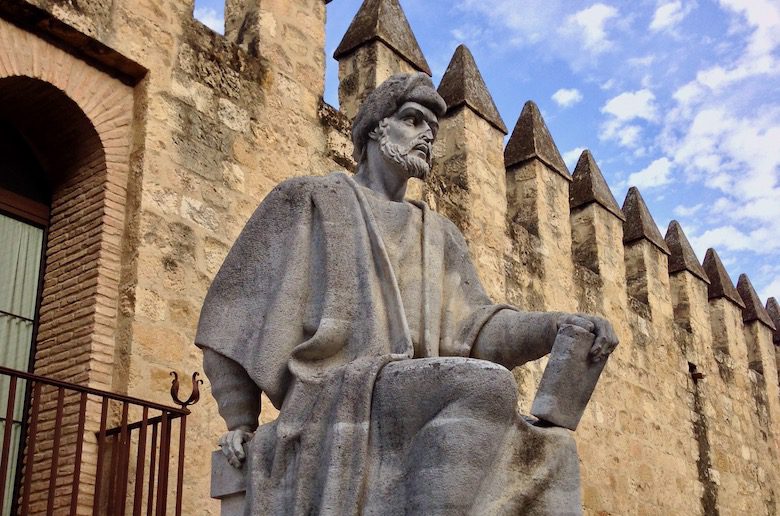
Statue of Ibn Rushd (Averroes) beside Córdoba’s ancient city walls. / CC. SALEEM ZOHAIB
His name was Latinized as Averroes. He was a judge, Islamic jurist, philosopher, and physician, perhaps the scholar who best represents the humanistic contribution of Al-Andalus to Western culture.
He is considered one of the forerunners of Western modernity. His central idea: faith and reason are not incompatible; on the contrary, they are different paths to the same Truth.
Where to find him: his statue stands on Calle Cairuán, near the Puerta de Almodóvar and Córdoba’s ancient city walls.
Abbas Ibn Firnas, the pioneer of aviation
(Ronda, Málaga, 810 – Córdoba, 887)
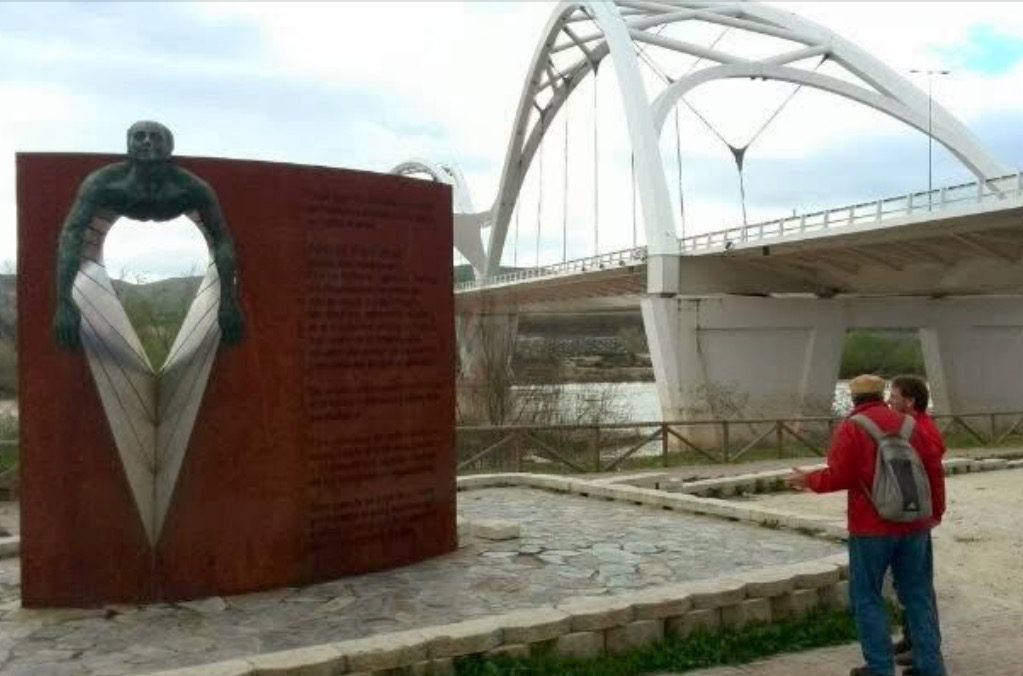
Wing-shaped bridge and commemorative monument dedicated to Abas Ibn Firnas in Córdoba. / WIKIMEDIA
According to historical chronicles, equipped with a rudimentary wing-like device he had designed himself, Ibn Firnas leaped into the air from a minaret in Córdoba and managed to glide for a few brief moments. He thus carried out what is considered the first known attempt at human flight using a device built specifically for that purpose. His invention preceded Leonardo da Vinci’s designs by more than six centuries.
That was not his only achievement. He was known for his contributions to astronomy (he built an armillary sphere and a planetarium in his home), clockmaking (he designed clepsydras, or water clocks), and techniques for cutting and producing rock crystal. He also stood out as a musician and poet.
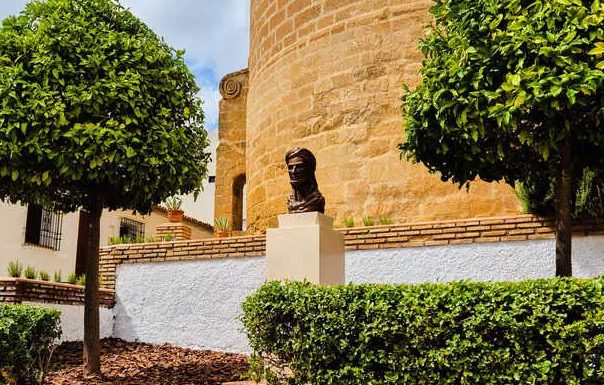
Where to find him: in Córdoba, a modern bridge spanning the Guadalquivir River, shaped like wings, pays tribute to him.He has also been honored in Ronda, his birthplace, but in a truly unusual setting: a museum that forms part of the world’s first designer olive oil mill (almazara), created by the renowned Philippe Starck. Dedicated to the tasting and enjoyment of extra virgin olive oil, the mill also houses a cultural museum that captures some of the essence of the region, including a tribute to the great pioneer of aviation.
Al-Idrisi, the great cartographer of the Middle Ages
(Ceuta, around 1100 – 1165/1166)
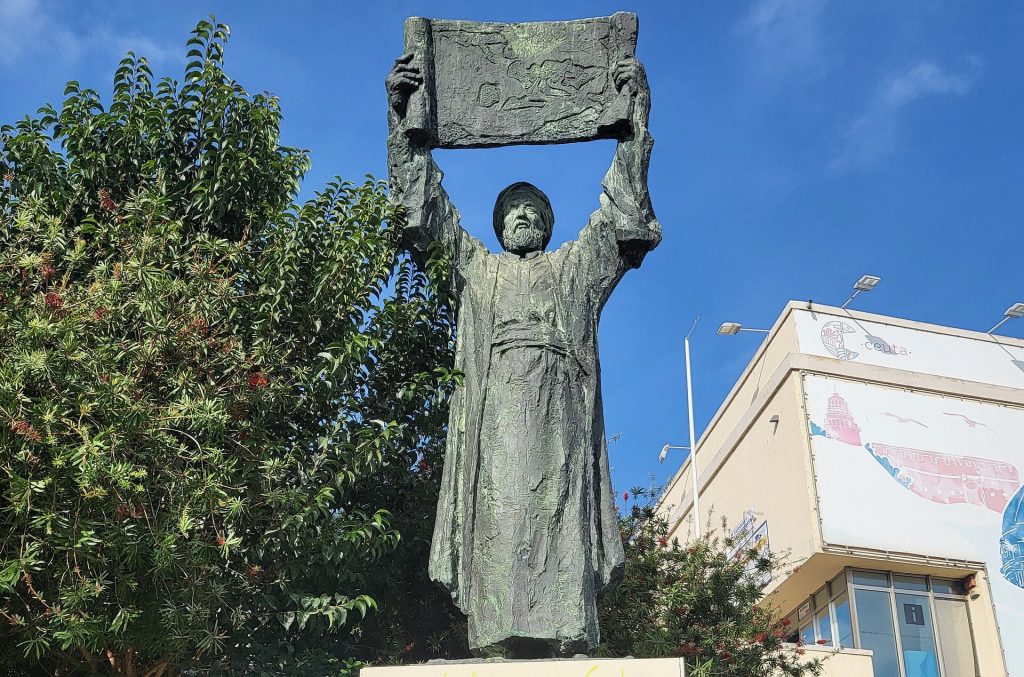
Statue of the geographer Al-Idrisi holding the ‘Tabula Rogeriana’ world map in Ceuta. / CC. XEMENENDURA
Muhammad al-Idrisi was one of the most outstanding geographers and cartographers of the Middle Ages. He was born in Ceuta, today a Spanish city in North Africa, into a family of Andalusi origin, and was educated in Córdoba. He traveled extensively throughout the Mediterranean and Europe, gathering geographical knowledge that he would later bring together in his great work.
His fame is particularly associated with the court of the Norman King Roger II of Sicily, who commissioned him to create a great map of the known world. The result was the celebrated Tabula Rogeriana, completed in 1154 and considered one of the most important cartographic works of the Middle Ages.
Al-Idrisi accompanied that map with an extensive geographical description of regions, cities, trade routes, peoples, and territories. His work brought together knowledge from the Islamic world and other traditions, offering a remarkably advanced representation of the world for its time.
And here’s an interesting detail: in his famous map, Al-Idrisi depicted the world with south at the top and north at the bottom, exactly the opposite of what we’re used to seeing today. It wasn’t a mistake: this was a common orientation in medieval Islamic cartography.
Where to find him: in Ceuta, a sculpture by artist Ginés Serrán-Pagán pays tribute to him. It depicts the great geographer holding a world map, a symbol of his extraordinary contribution to medieval cartography.
Ibn Hazm, the greatest poet of Al-Andalus
Abu Muhammad Ali Ibn Hazm (Córdoba, 994 – Huelva, 1064)
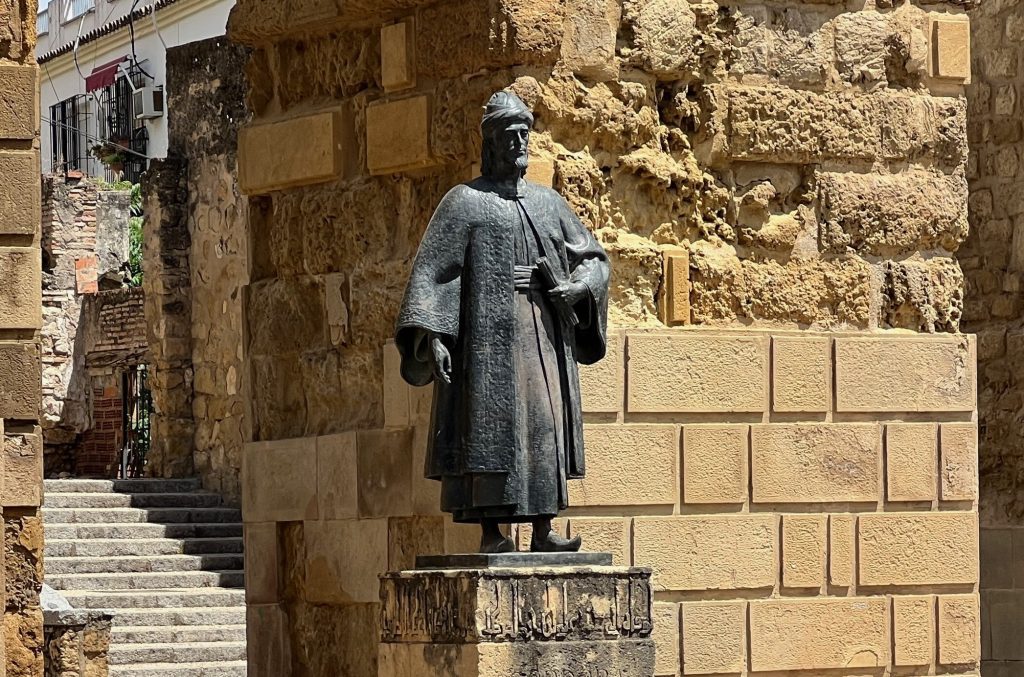
Statue of Ibn Hazm beside the Puerta de Sevilla gate and Córdoba’s ancient city walls. / CC. CHABE
He was one of the most celebrated philosophers, theologians, historians, writers, and poets of Al-Andalus. Ibn Hazm also defended the idea that the Earth was spherical, five centuries before Galileo, and maintained that there was a consensus among Muslim scholars on this fact.
He is considered the most important Andalusi poet and one of its great thinkers, as well as one of the pioneers of the comparative study of religions.
In 1022, he wrote his most famous work, Tawq al-hamama, or The Ring of the Dove, a book of reflections on the true essence of love. It is considered one of the most beautiful treatises on love in Arabic literature. But he wrote many more works. Historical sources attribute 400 volumes and more than 80,000 pages to him.
Ibn Hazm’s ancestors were Arabized Iberians who converted to Islam, known as Muwallads. He himself became vizier to some of Córdoba’s last caliphs. He lived through the fall of the Caliphate.Where to find him: his statue stands beside the Puerta de Sevilla, one of the ancient gates in Córdoba’s city walls.
Al-Gafequi, the great eye specialist
(Belalcázar, Córdoba ? – Córdoba, 1165)
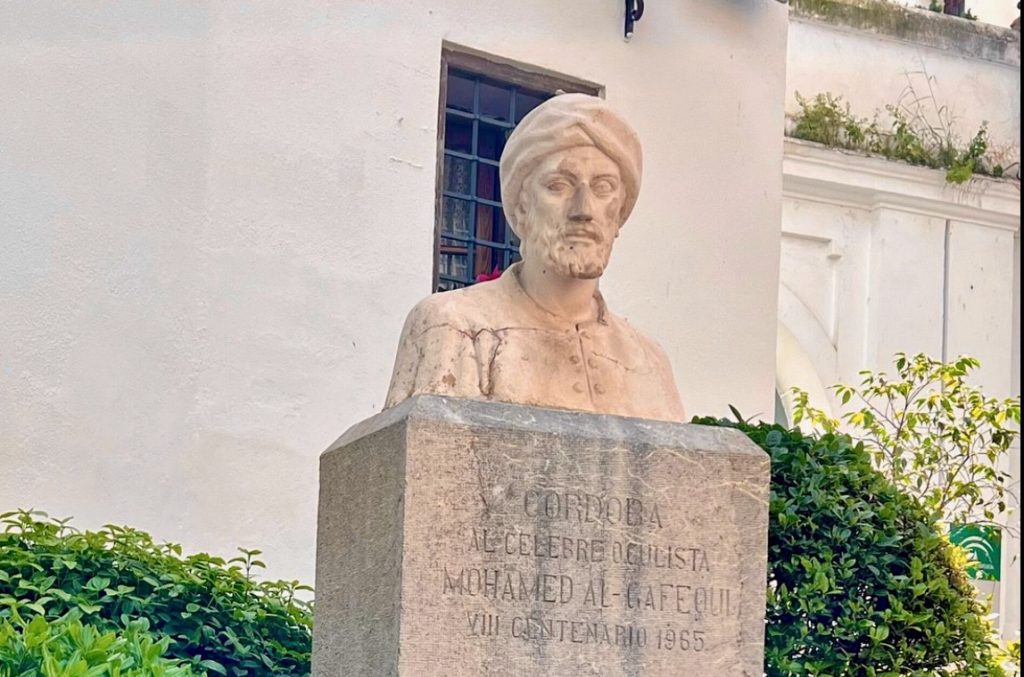
Bust of Muhammad Al-Gafequi in Cardenal Salazar Square, in Córdoba. / CC.
Muhammad Ibn Qassoum Ibn Aslam Al-Gafequi was a renowned physician specializing in eye diseases. He stood out for his knowledge of cataract surgery, contributed new ideas on surgical instruments for eye operations, and wrote a treatise on ophthalmology entitled Guide for the Oculist.
And a curiosity: have you noticed how much his name, Al-Gafequi, resembles the Spanish word gafas (glasses)?
Where to find him: his bust stands in Plaza del Cardenal Salazar, in Córdoba. In June 2026, another sculpture honoring Al-Gafequi was unveiled in Belalcázar, his birthplace in northern Córdoba province.
Al-Hakam II, the most learned Umayyad caliph
(Córdoba, 915–976)
Monument honoring Caliph Al-Hakam II in Campo Santo de los Mártires square, Córdoba. / CC.
He was the second Umayyad caliph of Córdoba. He succeeded his father, Abd al-Rahman III. During his reign, the Caliphate reached its greatest splendor.
He carried out the second expansion of the Great Mosque of Córdoba, perhaps the richest and most original of all. He extended the eleven aisles of the prayer hall southward, moving the qibla wall and building a new mihrab. This spectacular mihrab, conceived as a small octagonal chamber, is clad in marble and surrounded by extraordinary decoration. Al-Hakam II also introduced innovative domes with intersecting arches and complex combinations of multifoil, interlaced, and horseshoe arches, richly decorated and far more elaborate than those previously seen in the mosque.
In short, much of what will probably catch your eye when you visit the Mosque of Córdoba is thanks to this caliph.
Al-Hakam II also completed the construction of the impressive palatial city of Medina Azahara and promoted major urban improvements in Córdoba, including paved streets, street lighting, and sewer systems.
He also promoted education and is credited with founding 27 public schools, where paid teachers provided free education to poor and orphaned children, as well as encouraging education for young children.
And finally, what was perhaps one of his greatest contributions: the extraordinary library in the Alcázar which, according to historical chronicles, came to hold more than 400,000 volumes. That library became one of the great centers of learning in the Western world and a symbol of the cultural splendor of Al-Andalus. Unfortunately, it did not survive the end of the Caliphate.
Where to find him: his sculpture stands in Campo Santo de los Mártires, a picturesque garden square in the historic heart of Córdoba, opposite the Alcázar de los Reyes Cristianos and very close to the Great Mosque.
Musa ibn Maymun, Salahuddin’s physician
(Córdoba, 1135 – Cairo, 1204)
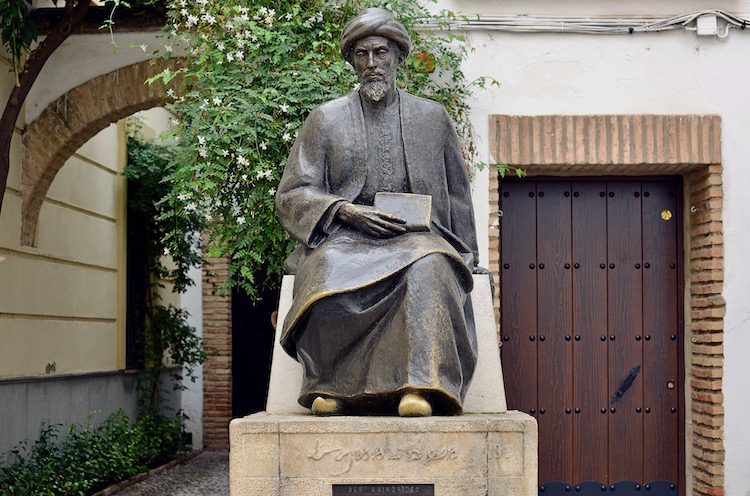
Statue of Musa ibn Maymun (Maimonides) in Córdoba’s Jewish Quarter. / CC. HARVEY BARRISON
His name was Latinized as Maimonides. He was the most important Sephardic Jewish philosopher, physician, and theologian of the Middle Ages. He wrote numerous pioneering medical treatises on asthma, psychosomatic illnesses, toxicology, and dietetics, most of them in Arabic.
Under Almohad rule, his family left Al-Andalus. In Cairo, where he would die in the early 13th century, he achieved enormous prestige as a physician. So much so that he became physician to Salahuddin al-Ayyubi and his court. One of his most celebrated works, Treatise on Poisons and Their Antidotes, was written at the request of Al-Qadi al-Fadil, one of Salahuddin’s principal advisers.
Jewish culture also experienced its Golden Age in Al-Andalus.
Where to find him: his statue stands in Plaza de Tiberíades, in the heart of Córdoba’s Jewish Quarter.
Wallada and Ibn Zaydun, great poets and lovers
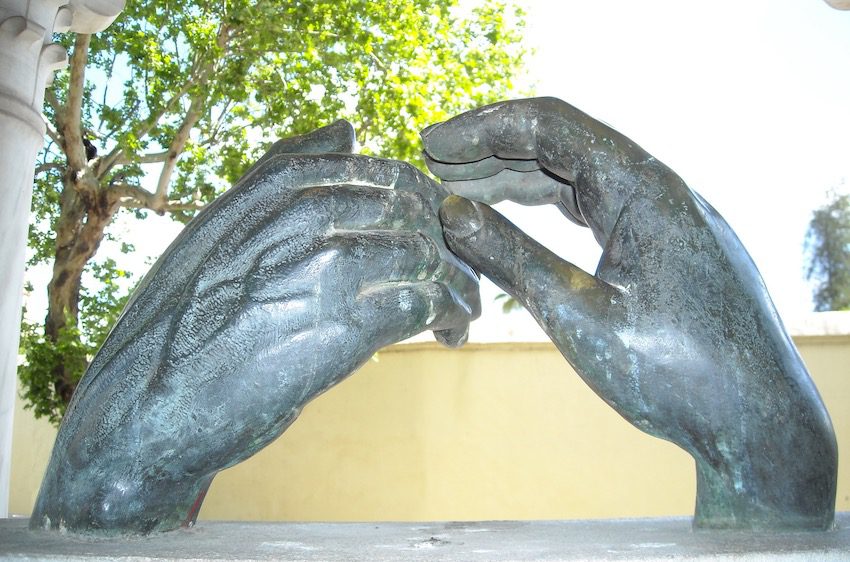
Two intertwined hands at the Monument to the Lovers, honoring the poets Wallada and Ibn Zaydun in Córdoba. / MARCO CHIESA
Wallada bint al-Mustakfi (Córdoba, around 1010–1091)
An Umayyad princess and daughter of Caliph Muhammad III al-Mustakfi, she became the most celebrated female poet of Al-Andalus and one of its most cultured women. According to some sources, the poet Ibn Hazm, whom we have also mentioned above, was her tutor.
After her father’s death, she lived independently, without guardianship, and opened a literary salon in her palace, where poets, jurists, writers, and travelers from the upper ranks of society gathered. It was there, during one of these gatherings, that she met the man who would become her lover, the poet Ibn Zaydun.
Wallada taught reading, writing, and poetry to other women of her time, regardless of their social standing.
Abu-l-Walid Ahmad Ibn Zaydun (Córdoba, 1003 – Seville, 1071)
He is considered one of the finest poets in Arabic literature and is studied as one of its classics at universities. The popularity he achieved during his lifetime through his poetry also opened the doors to politics, and he became a diplomat and vizier under several governments (the Taifa kingdoms), both in Córdoba and إشبيلية.
Wallada and Ibn Zaydun experienced a passionate and also turbulent love story, immortalized in the many poems they dedicated to and exchanged with each other.
In memory of their romance and their illustrious figures, in 1971 the Córdoba City Council dedicated the Monument to the Lovers to them: two intertwined hands, with some of the verses they dedicated to each other inscribed on the pedestal in Arabic and Spanish.
Where? In Campo Santo de los Mártires (Calle Tomás Conde, 12), beside the Alcázar de los Reyes Cristianos and the Caliphal Baths.
Zyriab, musician and “influencer”
(Mosul, 799 – Córdoba, 857)
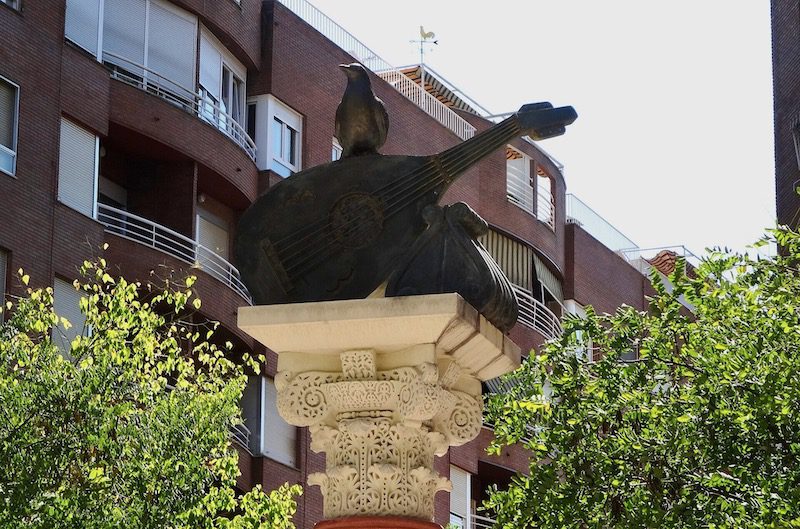
A lute and a blackbird are the central elements of the monument honoring Zyriab in Córdoba. / CC.
Abu Hasan Ali ibn Nafi, nicknamed Zyriab (“blackbird”) because of his dark complexion and excellent voice, was born in the lands of present-day Iraq but settled in Qurtuba (present-day Córdoba) in 822. He introduced the most refined music of the East to Al-Andalus, along with important instruments such as the lute (al-ud), to which he added a fifth string. He founded a medieval music school in Córdoba, considered one of the world’s earliest conservatories.
But besides being a musician and poet, using today’s language, we could say that Zyriab was a great and sophisticated “influencer.” Indeed, he introduced some of the refined customs to the Umayyad court that European courts would later adopt and that have survived to this day.
For example, he is credited with introducing the structure of banquets divided into courses (soups, main dishes, and desserts), the use of tablecloths, and the replacement of metal drinking cups with glassware.
He also popularized the custom of dressing according to the seasons, new hairstyles, the use of deodorants and toothpaste, and personal hygiene treatments inspired by the East.
Where to find him: since 2013, a commemorative sculpture depicting a lute and a blackbird has stood at Calle Músico Zyriab, 10, in Córdoba’s Poniente Sur neighborhood.
Al-Mansur, statesman and victorious military leader
(Torrox, Málaga?, around 938 – Medinaceli, Soria, 1002)
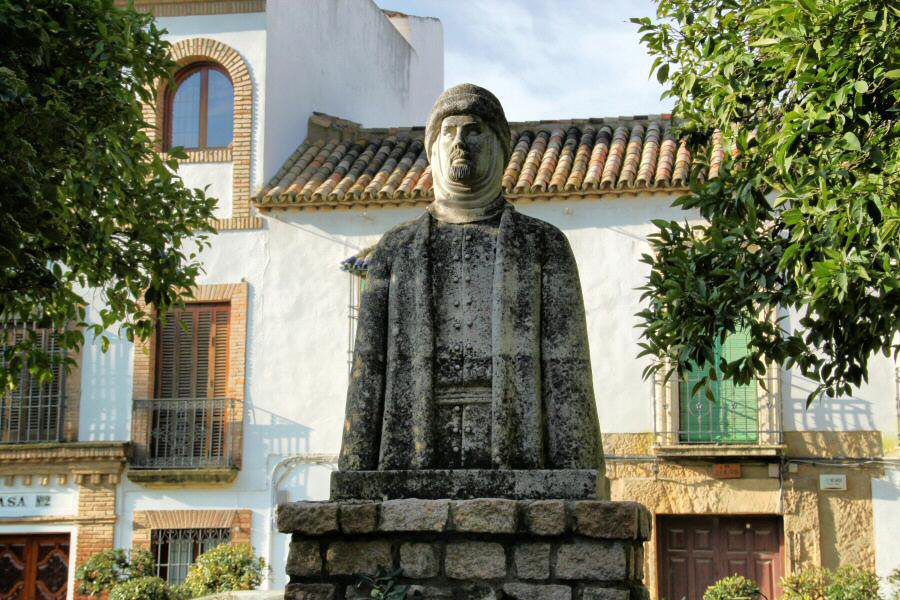
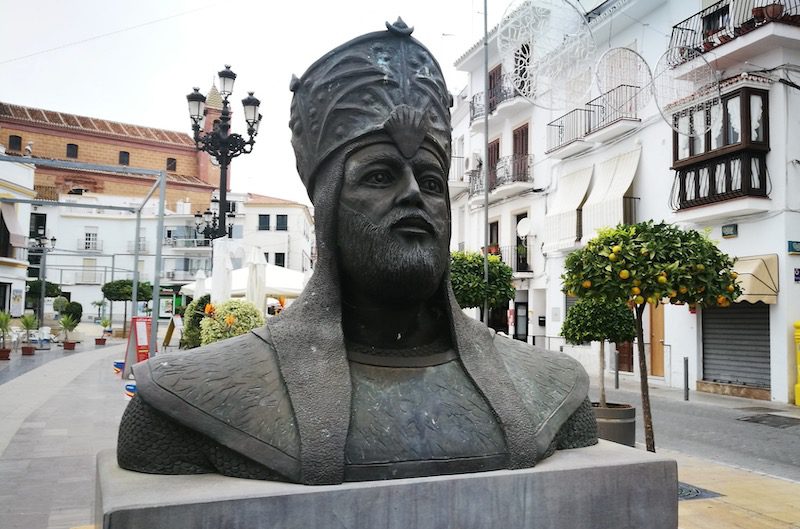
Bust of Al-Mansur in the main square of Torrox, Málaga province. / LET’S GO HALAL
Abu Amir Muhammad ibn Abi Amir, better known as Al-Mansur (“The Victorious”), was one of the most prominent political and military figures during the Caliphate of Córdoba.
Although he never became caliph, instead serving as hajib (a kind of prime minister), he effectively ruled Al-Andalus from 981 until his death in 1002. He administered the state, reformed the armies, and led more than 50 military campaigns against the Christian kingdoms without suffering a single defeat in them, becoming one of the most legendary figures of Al-Andalus.
He eventually fell seriously ill during his final military campaign and died in 1002 in Medinaceli, in what is now the Spanish region of Castile and León. At the time, the town was the capital of the Middle March, one of the frontier regions of Al-Andalus.
Where to find him: in Torrox, Málaga, you’ll find his bust in the town’s main square, Plaza de la Constitución.In Medinaceli (Soria), you can also find a commemorative epitaph dedicated to Al-Mansur, opposite the so-called Arab Gate (Puerta Árabe) in the ancient walls of this picturesque town.
Ibn al-Jatib, a pioneer in the fight against epidemics
(Loja, Granada, 1313 – Fez, 1375)
Bust of the Andalusi scholar Ibn al-Jatib in the town of Iznájar, Córdoba. / CC
Muhammad Ibn Abd-Allah Ibn al-Jatib was known by several honorific names. The most widespread was Lisān al-Dīn (“The Tongue of Religion”).
During the COVID pandemic, the Spanish media once again recalled this illustrious scholar from غرناطة: in the 14th century, he pioneered a scientific theory of contagion during the Black Death epidemic that devastated Granada and Europe in 1348. After observing how the disease spread, he addressed public health measures that were advanced for his time, such as isolating the sick and the risk of infection through sheets or clothing used by those who suffered from or had died of the plague.
Ibn al-Jatib was also a historian, philosopher, and poet. In fact, some of his poems are inscribed in the Alhambra, including in one of its most celebrated spaces, the Hall of Comares, also known as the Hall of the Ambassadors.
He was also a prominent political figure, excelling as grand vizier (wazir hajib) and serving as adviser and right-hand man to the emirs Yusuf I and Muhammad V of Granada.
Where to find him: in September 2024, a bust was dedicated to him in the Córdoba province town of Iznájar. Why in this town, where he was not born? As a great vizier and chronicler of the Nasrid Kingdom of Granada, he visited, studied, and extensively documented the frontier with the Christian kingdoms. It was he who immortalized the fortress of Iznájar (Hisn-Ashar) in his chronicles, giving it the famous title “the key to the frontier of the Nasrid Kingdom.”
Our journey ends here. These may be modest monuments, but if you come across any of them during your trip to Spain, you’ll know that their significance is far greater than the figures of stone, bronze, or steel they represent.
If you’d like us to organize a journey through the treasures of Al-Andalus and experience its extraordinary legacy firsthand, take a look at our tours designed for Muslim travelers.